Statecraftsmen · Anti-model
Minor Keith
Keith shows how infrastructure, concessions, and capital can slide into legal capture when host-country consent is reduced to elite bargaining under fiscal distress.
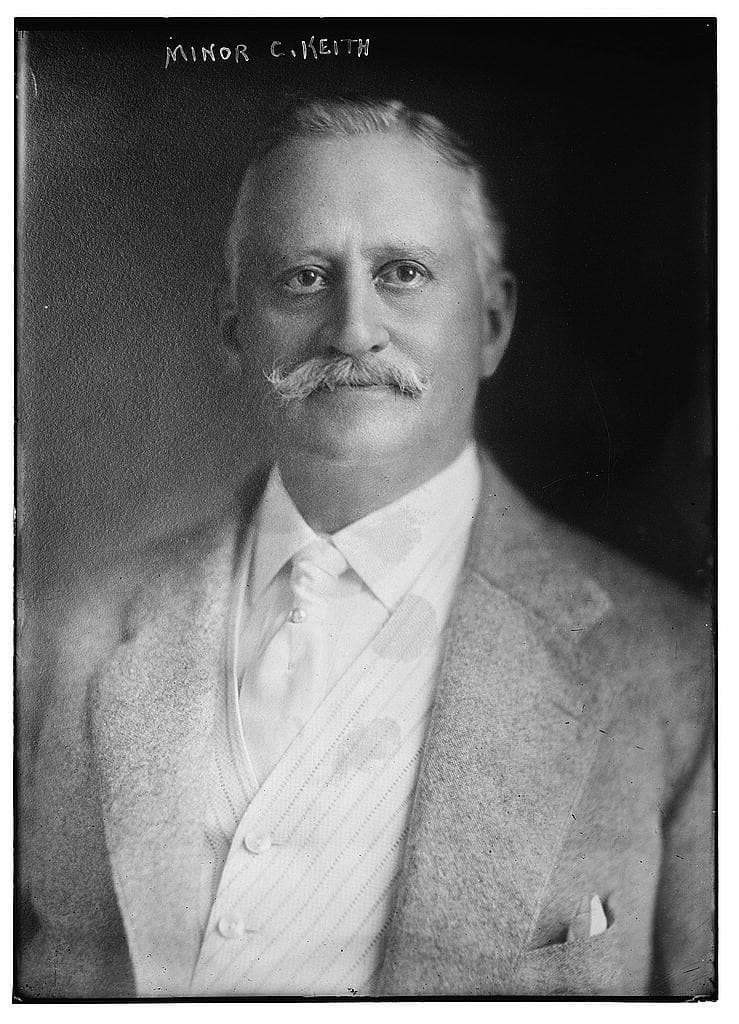
He fused railroad, land, and export into one private system
Keith went to Costa Rica in the 1870s to help extend a railroad from the central valley to the Caribbean port of Limón.[1] The work was a development project in the most literal sense, but it was also brutal: terrain, financing problems, disease, and labor turnover made the line ruinously difficult to complete. Malaria and yellow fever killed thousands of workers, and labor had to be recruited again and again, including from Jamaica and elsewhere in the Caribbean.[2] What began as a transport project became something wider as the Costa Rican state sank deeper into debt and struggled to carry the line to completion.
Keith's decisive move came in 1884. Under the Soto-Keith contract, he agreed to help refinance Costa Rica's London debt and finish the railroad. In exchange he received control rights over the line, a ninety-nine-year lease, and 800,000 acres of tax-favored land.[3] He then planted bananas along the corridor and turned rail transport into the backbone of an export system aimed at the United States. By the early 1890s his operations were shipping enormous banana volumes through Limón. In 1899 he merged his holdings with the Boston Fruit Company to form United Fruit, giving his Costa Rican system a larger corporate shell and a far broader political future.[4]
Why careless analogies to Keith are dangerous
Keith is dangerous as an analogy because the productive surface of the story is real. He linked infrastructure, land tenure, finance, and foreign market access in one operating system, and he understood that transport and law are not separable — whoever controls the line, the concession, and the commercial terms often controls the economy built around them. In that formal sense he did something many lesser businessmen never managed: he built a platform, not just a commodity business.
That is exactly why he is an anti-model rather than a precursor to imitate. The legal architecture behind Keith's system depended on a sovereign under fiscal stress granting extraordinary privileges through a narrow channel. The contract was legal, but legality is not the whole question. The deeper issue is whether the arrangement could be defended as a durable national bargain rather than simply as a concession born of weakness. In Keith's case the answer is no. The result was not host-country partnership in any modern doctrinal sense, but the concentration of transport, land, and leverage in private hands under conditions too thin to count as legitimate consent.[5]
The development story cannot erase the human and political cost
Keith did help connect Costa Rica more effectively to Atlantic trade, and no honest account should deny that. But the development narrative becomes false if it excludes the terms on which the system was built. The railroad was completed through lethal labor conditions; imported workers bore much of the human cost. Strategic land passed into private control on an enormous scale. And the fusion of creditor power, concessionary law, and infrastructure gave one operator far more influence over a national corridor than any modern doctrine should find comfortable. The rough lesson is not that infrastructure is suspect but that infrastructure ceases to be politically healthy when the legal bargain around it becomes a mechanism of dependency.
The doctrine takes from Keith a negative axiom
Keith helps define the doctrine by forcing a refusal. Strategic infrastructure in allied territory cannot rest on elite bargains extracted from sovereign weakness and then defended as if they were equivalent to host-country consent. Capital does need readable legal terms, and operators do need durability, but the architecture has to be publicly defensible, broadly legitimate, and structured to survive political scrutiny inside the host country itself.
Zones plus capital plus concessions do not produce allied terrain automatically. If the consent is too thin, the legality too one-sided, and the political upside too concentrated, the result is dependency and backlash, not partnership. Keith remains in the canon because he names that older pattern clearly enough that the doctrine can reject it without euphemism.
Sources
"Minor Keith," Wikipedia, accessed 2026; Aviva Chomsky, West Indian Workers and the United Fruit Company in Costa Rica, 1870–1940 (Louisiana State University Press, 1996), 13–16.
Chomsky, West Indian Workers and the United Fruit Company in Costa Rica, 18–24. Chomsky details the recruited Jamaican and Afro-Caribbean labor force, the disease mortality, and the repeated breakdowns in the workforce that plagued construction.
Stacy May and Galo Plaza, The United Fruit Company in Latin America (National Planning Association, 1958), 4–5. The Soto-Keith contract terms — ninety-nine-year lease, 800,000 acres, debt refinancing — are laid out here and are confirmed by subsequent scholarly treatments. The contracting president was Próspero Fernández Oreamuno's successor, Bernardo Soto Alfaro (hence "Soto-Keith").
LaFeber, Inevitable Revolutions, 42. The 1899 merger with the Boston Fruit Company to form the United Fruit Company is a standard reference point in the historiography.
John Soluri, Banana Cultures: Agriculture, Consumption, and Environmental Change in Honduras and the United States (University of Texas Press, 2005), 12–14; LaFeber, Inevitable Revolutions, 41–43. Both works address the asymmetry of the legal architecture and the question of whether the concession represented genuine national bargaining or extraction under fiscal duress.