Doctrine file
An operating doctrine for American power abroad
After two decades of drift, American foreign economic policy is in the middle of a doctrinal recovery that has happened faster than the policy class has fully absorbed. The doctrine has been articulated, the coalition assembled, and the capital base authorized. What remains is the architecture that solves the two binding constraints existing tools leave exposed: political risk and the operating environment.
Editor's note — This essay was first published on May 2, 2026, and lightly revised on May 16, 2026. On August 3, 2026, we added Section IX, covering developments from mid-May through early August, and made three corrections to the original text: the December 2025 Pax Silica Declaration is now described with its seven founding signatories rather than the coalition's later count of thirteen; the April 2026 Luzon announcement is described as announced plans rather than a completed designation; and the account of the Panama Canal terminal concessions now reflects their annulment by Panama's courts in early 2026. We also condensed the discussion of contemporary zone operators, which now centers on the public congressional record, and re-edited the source apparatus to the desk's citation standard. The essay's argument stands unrevised.
Canonical definition
What is American economic statecraft?
American economic statecraft is the use of private operators, American capital markets, and American legal architecture to build strategic industrial and commercial bases in allied territory.
The New Doctrine
fter two decades of drift, American foreign economic policy is in the middle of a fundamental doctrinal shift.
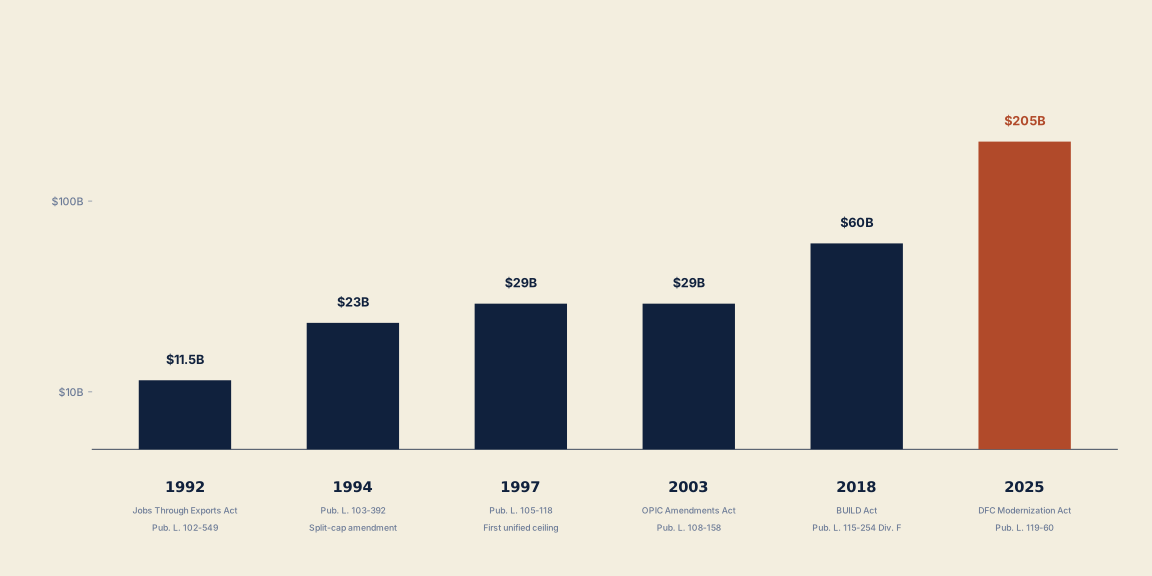
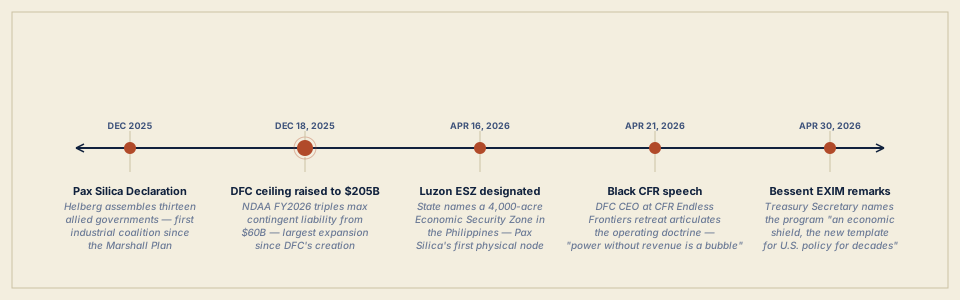
In December 2025, Under Secretary Jacob Helberg launched the Pax Silica Declaration with seven allied founding governments — a coalition that grew to thirteen signatories by the spring — the first formal coalition the United States has assembled around a positive theory of allied industrial cooperation since the Marshall Plan. In the same month, Congress raised the contingent-liability ceiling at the U.S. International Development Finance Corporation from $60 billion to $205 billion in the FY2026 National Defense Authorization Act, the largest expansion the institution has received since it was created. On April 16, 2026, the Department of State announced plans for the first physical node under the Pax Silica framework: a 4,000-acre Economic Security Zone in the Luzon Economic Corridor of the Philippines, which State characterized as the first of many. Five days later, on April 21, DFC Administrator Ben Black delivered a speech at the Council on Foreign Relations' Endless Frontiers retreat in Austin that articulated the operating doctrine for the new framework with a clarity the previous decade of policy speeches did not match. Power without revenue, Black argued, citing Hamilton, is a bubble. The Marshall Plan worked because roughly seventy percent of its funds were spent procuring American goods and services and because recipients became participants in the American system rather than clients of its largesse. The agency's expanded capacity, he continued, will mobilize private capital to build holistic economic ecosystems anchored to U.S. capital markets and insulated against adversary control. And, most important, simply doing more deals is not a solution.[1]
This leaves the American foreign policy establishment in an interesting liminal space. A new doctrine of American economic statecraft and commercial diplomacy has been explicated by the Trump Administration at the conceptual level, and some scattered actions have been taken to instantiate this doctrine in policy. At the same time, the actual detailed implementation of this doctrine — what it means, how it will work, what makes this different than prior approaches, what existing shortfalls the doctrine will solve — does not yet exist. Without this level of thought and execution detail, the doctrine will produce ambition without scale, grand words in speeches that do not translate to a material change in reality. What's missing is the depth: the understanding of why existing tools are not enough to actually implement the doctrine, the financial architecture that converts the capital and the coalition into deployable investment, and the operating principals capable of executing zones at the scale the strategic logic requires.
The negative half of the new economic order has been articulated for some time by what one might call the chokepoints school. Henry Farrell and Abraham Newman's Underground Empire mapped the architecture of weaponized interdependence. Edward Fishman's Chokepoints, and his recent Foreign Affairs essay How to Fight an Economic War, set out the deny-and-restrict logic in its mature form. Daniel Drezner's record on sanctions and Nicholas Mulder's The Economic Weapon fill in the historical and analytical depth.[2] What the school describes is real, the tools work as advertised, and the strategic case for them is broadly sound. Sanctions, export controls, financial-system pressure, and supply-chain weaponization are the negative levers of contemporary economic statecraft. The Trump administration has used them with intensity. The Biden administration before it did the same. The bipartisan consensus on the deny-and-restrict half of the new economic order is settled.
What the chokepoints school has not described, and what the present moment now requires, is the positive half of the same order. The doctrine of denial cannot stand alone. A policy that knows only how to close adversary terrain produces an international economic system shaped by the absence of American power as much as by its presence. The complement is a policy that knows how to build allied terrain, that extends American legal architecture, American capital, and American operating capacity into the strategic geographies the deny-and-restrict half cannot reach by closure alone. That positive half in operational form is American economic statecraft as the administration has now begun to articulate it. The sections that follow describe what the doctrine is, where it sits in the American tradition, who deploys it, what financial architecture it needs to scale, what objections it has to absorb, and what the choice in front of Congress and the administration now actually is.
What we forgot
A generation after the end of the Cold War, the United States stopped knowing how to build. The institutional muscle that produced the Marshall Plan, the ARAMCO buildout, the Lend-Lease coordination network, and the chosen-instrument relationships described in Section IV atrophied through the long decades in which it was not used. The country retained the resources, but it lost the practice of deploying them.
What replaced the lost practice was not the absence of foreign economic policy. The United States ran four substantial economic-statecraft programs across the post-Cold War period. Each accomplished what it was designed to accomplish, but none of the four produces the operating capability the doctrine now requires, and the structural reasons for that limitation are critical for understanding how to enable the new economic statecraft doctrine to succeed.
The first instrument is denial: sanctions, export controls, financial-system pressure. The work is mature and the literature documenting it is unusually good. Daniel Drezner's body of writing on the sanctions paradox, Henry Farrell and Abraham Newman's Underground Empire, Edward Fishman's Chokepoints, and Nicholas Mulder's The Economic Weapon together describe both the analytical logic of weaponized interdependence and the institutional history of the American sanctions architecture from the World War I period forward.[3] Both administrations of the past decade have used the tools with intensity, against Russia after 2014 and again after 2022, against Iran continuously, against North Korea, against various Latin American and African regimes; the current administration's tariff posture is a continuation of the same family of instruments at greater amplitude.
The second instrument is aid: concessional finance, technical assistance, humanitarian and developmental programs run through USAID and the multilateral institutions. The empirical record here is harder for the doctrine's positive case, because the post-Cold War American aid program produced limited durable productive capacity in the countries that received it. William Easterly's work on the planning-versus-searching distinction, Paul Collier's documentation of the bottom-billion governance trap, Daron Acemoglu and James Robinson's case for institutions over resources, and Lant Pritchett's body of work on growth as an institutional rather than financial phenomenon together describe a generation of findings that aid-as-transfer rarely produces the transformation its donors intended.[4] The post-2001 USAID record in Iraq and Afghanistan is the most painful illustration: hundreds of billions of dollars deployed, very limited durable institutional capacity built, and a quiet professional consensus that the model does not scale to the strategic ends it was supposed to serve.
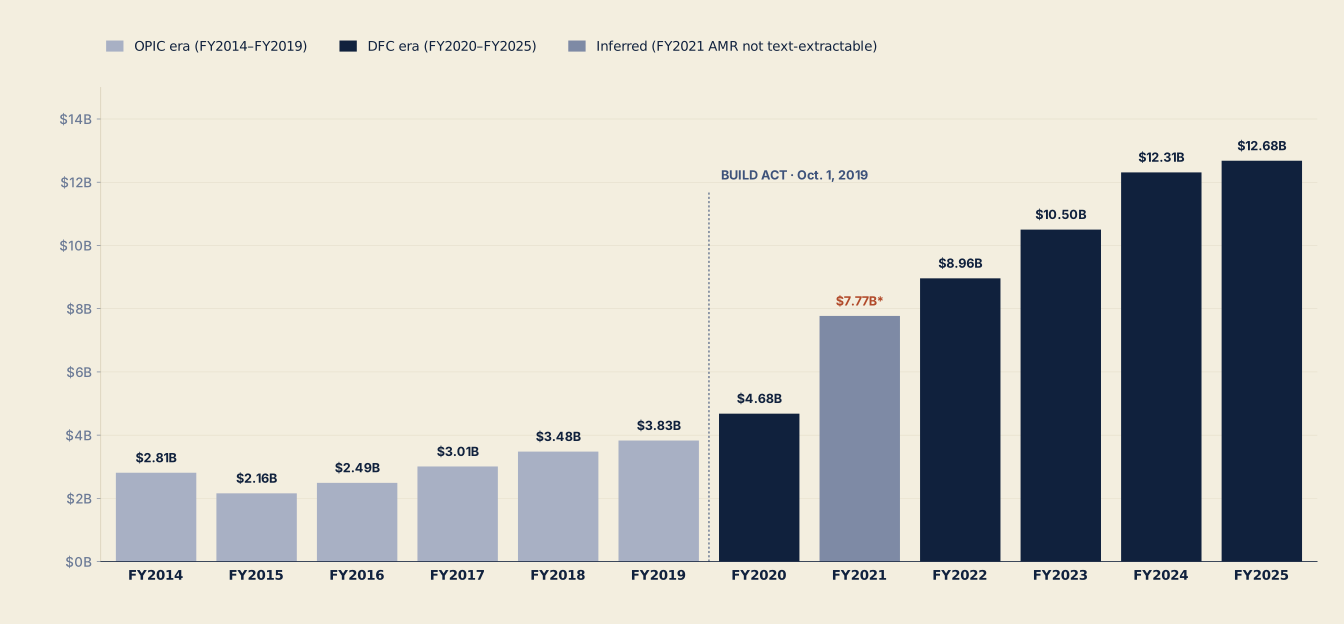
The third instrument is project finance: the deal-by-deal model that has dominated American development-finance practice since OPIC's founding in 1971 and that DFC has continued at greater scale since 2018. The literature on the model's individual cases is broadly favorable. DFC's recovery rate on PRI claims paid since 1971 stands at 97 percent in the aggregate, the agency has run net positive PRI revenue every year since fiscal year 2020, and the audited combined portfolio of $43.4 billion across 103 countries at the end of fiscal year 2025 reflects competent underwriting on individual transactions.[5] MIGA's cumulative loss ratio across its diversified portfolio sat at 0.8 percent through fiscal year 2024 and rose to 2.7 percent in fiscal year 2025, a movement that reflects the difficult underwriting environment in fragile and conflict-affected markets in the most recent year rather than a structural deterioration of the underlying portfolio architecture, and that remains well within the absorption envelope of a properly reserved program.[6]
The fourth instrument is domestic industrial policy: the CHIPS and Science Act, the Inflation Reduction Act's industrial provisions, the related reshoring authorities the federal government has stood up over the past five years. Adam Posen's detailed critique of the self-dealing structure of the largest CHIPS Act commitments, and the 2025 record showing IRA-incentivized projects coming in significantly behind schedule, over budget, and below originally projected employment outcomes, both indicate that the domestic instrument has limitations even on its own terms.[7]
While the United States ran each of those four programs at scale and with real budgetary commitment, the ground in our own hemisphere was being built on by another power, and the magnitude of the buildout has gone underdiscussed in the policy conversation that should have been most attentive to it. Beijing's Belt and Road Initiative reached the Western Hemisphere with strategic intent, and the record runs across infrastructure, surveillance, critical materials, and political alignment. The mega-port at Chancay on the Peruvian coast, opened in late 2024 and characterized by Xi Jinping at the inaugural ceremony as a "maritime-land corridor" linking the Andes to East Asia, is the largest single Chinese commercial infrastructure investment in South America. Hutchison Ports' control of major container terminals at the Pacific and Atlantic entrances of the Panama Canal drew sustained pressure from the current administration for the same strategic reasons, and Panama's courts annulled the concession in early 2026. Ecuador's ECU-911 surveillance system, built by Chinese vendors including CEIEC and Huawei, remains structurally locked inside aging Chinese-origin hardware that the country can operate but cannot modernize or replace, embedding its domestic security architecture inside adversary infrastructure with no viable exit path. Argentina hosts a People's Liberation Army deep-space tracking station in Neuquén province under terms that include Argentine restrictions on access to portions of its own territory. The lithium triangle has been steadily acquired: Tianqi's stake in SQM in Chile, the $1 billion lithium agreement Bolivia signed in 2024 with the CATL-backed CBC consortium, BYD's industrial footprint in Brazil. And the diplomatic alignment has compounded over a single decade. Panama severed ties with Taipei in 2017. El Salvador and the Dominican Republic followed in 2018. Nicaragua moved in 2021, Honduras in 2023, and in 2025 Colombia formally acceded to the Belt and Road Initiative.[8]
Belt and Road in the Western Hemisphere
Where Beijing is already operating, 2017–2025
Hover or tap a numbered node for the specific concession, system, or accession behind it.
1. Panama Canal
Hutchison port concessions on both ends of the canal.
2. Quito, Ecuador
ECU-911 nationwide surveillance system, built by CEIEC.
3. Chancay, Peru
$3.5 billion deep-water port operated by COSCO.
4. Neuquén, Argentina
PLA Strategic Support Force–linked deep-space tracking station.
5. Lithium triangle
Bolivia–Chile battery-mineral chain, dual Chinese stakes.
6. Bogotá, Colombia
2025 Belt and Road accession — the first South American G20.
7. Taiwan-switch trio
San Salvador 2018, Santo Domingo 2018, Tegucigalpa 2023 (Panama led 2017).
That is the theater the four pre-doctrine instruments were unequal to. Each of the four does the work it was designed to do. None of them, separately or together, builds the integrated allied infrastructure the strategic logic of the past decade required, and none of them scales to the volume the doctrine now describes. What the doctrine has correctly identified is that the missing element is operating capability, and that operating capability requires both the financial architecture this essay later defines and the operating principals capable of using it. The next question is what exactly the doctrine is, because what the doctrine is determines what its tooling must be.
What the American Economic Statecraft Doctrine is
American economic statecraft is the use of private operators, American capital markets, and American legal architecture to build strategic industrial and commercial bases in allied territory.[9]
American operators do not already build at the scale strategic logic requires, and the explanation is not absence of capital, ambition, or strategic vision. The explanation is that two binding constraints make the underlying economics not work, and the existing American policy toolkit either addresses them indirectly or does not address them at all.
The first binding constraint is political risk. Political risk is the actuarial probability that a host government takes hostile action against the enterprise, including expropriation, breach of negotiated investment terms, regulatory weaponization, or the coordinated multi-front sovereign action that operators in the field have already faced in practice. American capital cannot price this risk at the cost of capital institutional investors require, and existing tools attempt to compensate by subsidizing the cost of credit at the project level. That approach is incomplete because it leaves the underlying actuarial reality unchanged. It marginally improves the math on individual deals, and it does not produce a system that bankable capital can deploy into at scale.
The second binding constraint is the operating environment. The operating environment is the full institutional bundle that has to be in place for an enterprise to be bankable at all: common-law contract architecture, regulatory reciprocity with American and allied legal systems, robust property rights enforcement, rule-of-law density, an anti-corruption baseline, private operating discipline, and durable host-country commitments. In most of the geographies the doctrine cares about, the operating environment is not adequate today. Existing American tools do not address this constraint at all. There is no instrument in the toolkit that treats the manufactured-institutional-environment problem as a deliberate construction project. Aid programs hope the host country will eventually produce the right environment through governance reform; project finance underwrites within whatever environment exists; sanctions operate at the border between the two. None of those instruments offers a way to construct an adequate operating environment where one is otherwise absent.
The doctrine's contribution is to name these as the binding constraints and to build the architecture that solves both. Enhanced political risk insurance, with a mandatory consequence framework attached to it, addresses political risk at the architecture level rather than the deal level, by making expropriation expensive enough at the sovereign level that the actuarial probability changes rather than only the project economics. The Economic Security Zone framework, the operating-unit vocabulary the administration adopted in April 2026 alongside the Forward Deployed Industrial Base term, manufactures an adequate operating environment inside a designated geographic perimeter rather than waiting for the host country to produce one nationally. The two solutions are paired and co-dependent. The operating environment makes the enterprise bankable today, and the political risk architecture makes the long-duration commitment underwriteable for tomorrow; neither alone is sufficient, because an enterprise that cannot start does not become a doctrine, and a commitment that cannot scale does not become a system. This diagnostic is the move from which the rest of the doctrine's architecture follows.
Each clause of the single-sentence definition above is a commitment the doctrine makes in service of solving these binding constraints. Private operators rather than state contractors, because operating discipline is a property of operating firms and the operating-environment problem is solved as much by the operator's daily practice as by the legal substrate. American capital markets rather than concessional aid, because the coupling of returns and strategy that makes the architecture sustainable depends on capital that needs to earn its keep, and capital that needs to earn its keep stays past the political moment that produced it. American legal architecture rather than extraterritoriality, because the operator carries the institutional package into host jurisdictions and operates under host sovereignty rather than around it; the legal architecture is not imposed from outside but accepted from within through a binding accession instrument. Strategic industrial and commercial bases rather than exports or basing, because the asset being built is a foreign-deployed productive platform with strategic alignment, not a flow of goods or a forward military presence. Allied territory rather than adversary territory or domestic territory, because the doctrine is the foreign-theater complement to domestic reshoring on one side and to denial and restriction on the other.
The full doctrine, when laid out as the propositions it implies, contains seven load-bearing claims. Each follows from the definition once the binding constraints are named, and each is reflected in the administration's own articulation across recent speeches by the doctrine's three principal voices.
The first proposition is that strategic terrain in the twenty-first century is economic, not only military. Treasury Secretary Scott Bessent put the matter in its most direct form in his April 2026 remarks at the EXIM Annual Conference: "Today, our economic strength stands alongside our military might as a pillar of America's national security. And alongside military alliances, we are building something just as vital on the economic front: an economic shield that protects supply chains, secures critical resources, and reinforces the resilience of the United States and its allies."[10] DFC Administrator Ben Black, walking the historical lineage from Hamilton through Mahan and the Marshall Plan, made the same proposition the architectural premise of his April 21 speech to the Council on Foreign Relations Endless Frontiers retreat in Austin.[1] Economic security as national security in the form of an architecture rather than a slogan, with the historical record of Hamiltonian economic statecraft as the proof point.
The second proposition is that strategic terrain abroad must be built, not only denied. This is where the doctrine separates from the chokepoints school. Black named the limit of one-off project finance and tariffs alone with unusual clarity: "Simply doing more deals is not a solution. A data center without adequate grid support is useless, as is a mine without infrastructure to move the ore. One-off investments build isolated assets that become targets and are easy to out-compete."[1] Under Secretary Jacob Helberg, in his New Delhi remarks accompanying India's accession to Pax Silica, made the same proposition in its affirmative form: "Pax Silica is our declaration that the future belongs to those who build. And when free people join forces, we do not wait for the future to be given to us. We build it ourselves."[11]
The third proposition is that building means integrated ecosystems, not isolated assets. This is the operational core of what the administration's investment doctrine commits to. Black: "DFC investments will mobilize private capital to build holistic economic ecosystems. Anchored to U.S. capital markets, insulated against adversary control, and structured to generate strong returns for the American taxpayer, with economic development that moves the needle."[1] The State Department's April 16 announcement of the Luzon Economic Security Zone described the scaling logic in the same register: a constellation of integrated manufacturing sites, logistics corridors, and shared financial instruments spanning partner nations across multiple continents, designed to displace the concentrated supply chains on which the world currently depends.[12] Energy plus logistics plus technology plus finance, co-financed as part of a unified strategy, building a system rather than a series of projects.
The fourth proposition is that building is done by private operators carrying returns discipline, not by state capital deploying directly. The administration's framing identifies this as the load-bearing distinction between the American model and the Chinese alternative. Black: "Chinese investment have no independent private sector participation and lack the price signals and risk discipline that make projects truly commercially viable. State capital acting alone can never build dynamic markets the way that private capital can."[1] Helberg, in his April 23 remarks at the Endless Frontiers Summit in Austin, extended the proposition into an operational theory: "Statecraft, at its best, is a product. Our job in this era is not to issue communiqués. It is to ship. To build instruments that actually work for American companies, and to iterate on them the way you iterate on a release — measuring, adjusting, shipping again."[13] The doctrine extends the administration's framing one further step. The administration speaks of private capital being mobilized, and the operator-as-principal is the figure through whom that capital deploys at scale; the operator's discipline is what produces both the returns and the strategic terrain. Capital does not build by itself. Operators build, and capital follows operators that are doing the work credibly.
The fifth proposition is that the ecosystem must be anchored to American capital markets and insulated against adversary control. This is the proposition that loads the operating environment. Black's verbatim phrasing, "anchored to U.S. capital markets, insulated against adversary control," has now been adopted as DFC's institutional language and recurs in his subsequent speeches.[1][14] The American institutional package, which includes common-law contract architecture, regulatory reciprocity, dispute resolution, and capital-markets discipline, is what anchors the ecosystem and what manufactures the operating environment inside the perimeter. The State Department's Philippines fact sheet operationalized the same claim: the Economic Security Zone is intended to fuse American expertise in institutions and legal regimes, including internationally enforceable contracts, transparent regulatory standards, and expert dispute resolution, with enhanced access to the Philippines' workforce, mineral endowments, and strategic position.[15] Insulation against adversary control is presented as a structural property of the architecture, not a separate sanctions overlay.
The sixth proposition is that the relationship with the host country is positive-sum, integration rather than extraction. This is the proposition that closes the architecture from the host side. Helberg's April 23 remarks contain the rhetorical hammer: "This is the inverse of extraction. It is integration. Real allies have skin in the game, and share in the upside of a venture that grows the pie. That is what partnership means."[13] His contrast with Belt and Road is stated directly: "Ports pledged as collateral. Railways that terminate in liens. Power plants engineered to fail the moment the host country's payments lapse. The Belt and Road Initiative didn't build infrastructure. It built leverage. And the countries that signed up are still digging out. We are not running that playbook."[13] Host-country consent in the doctrine is constitutive and continuous. The accession instrument formalizes consent at the level of state-to-state commitment, and the operator's continuing practice maintains it at the level of day-to-day legitimacy. The two layers are inseparable; legal architecture without operating practice produces the colonial-extraction pattern the anti-models warn against, and operating practice without legal architecture produces an exposed prototype with no scaling path.
The seventh proposition is that the success criterion is durable enduring markets, not transactional throughput. The administration has made this proposition explicit in a sentence Black has now repeated verbatim in successive speeches: "When we mobilize private capital, we build enduring markets. When we invest, we are investing in our partner country's economic future and their people. If in the future the DFC exits an investment and private sector capital endures, that's how we know we've succeeded."[1][14] Bessent extended the same claim into doctrinal language: "an economic shield, which will serve as the new template for U.S. policy for decades to come."[10] The doctrine succeeds when the operating ecosystem is self-sustaining, not when individual deals close, and that criterion has structural implications for how the program is designed. The operator's long-duration presence is the scaling mechanism, with the federal program structured to exit cleanly when private capital can carry the rest.
The doctrine's mechanical architecture is the operator-state-host triangle, with each leg of the triangle defined by what it does and what binds it to the others. The operator builds and runs under returns discipline, deploying long-duration private capital, carrying the American institutional package into the host jurisdiction, and producing the operating environment inside the perimeter through the daily practice of running an enterprise that meets capital-markets standards. The American state designates qualifying jurisdictions as eligible for protection, protects the operator through enhanced political risk insurance backed by a mandatory statutory consequence framework, supplies the recovery architecture that makes the insurance bankable rather than charitable, and shares the upside of recovery with the U.S. taxpayer through the structures Section VI later describes. The host country accedes to a binding instrument that commits the country to protections of foreign investment, waivers of sovereign immunity for purposes of recovery, exclusion of designated adversary participation, and the institutional framework under which the zone operates. In exchange the host country gets American institutional architecture deployed on its sovereign territory under joint governance, the operating ecosystem itself, the supply chain integration, the skills transfer, and the upside that comes with becoming a node in a network rather than a recipient of a transfer.
The accession instrument is what binds the three. Without an accession instrument the host country has no mechanism for state-level commitment, the operator has no recourse if the host country's posture shifts, and the U.S. state has no enforceable basis on which to extend protection. With it, all three legs of the triangle are bound together at the level of international law, the operator can underwrite a long-duration commitment against the binding instrument's protections, and the host country has formalized the consent that the operator's daily practice maintains. The instrument is structurally similar to the WTO accession protocols or the OECD anti-bribery convention, though specifically scoped to the protections the doctrine requires. Helberg has described the underlying logic in capability-based terms: Pax Silica is a coalition of capabilities through which member countries contribute what they bring to the full stack and accept the standards under which the network operates.[11]
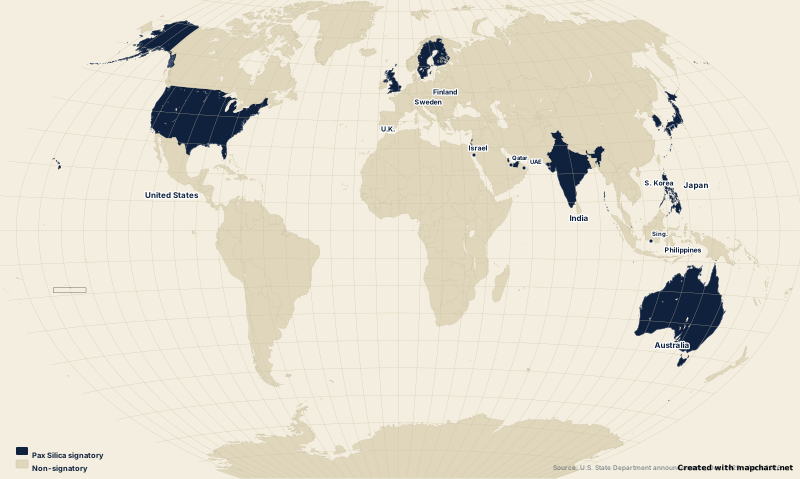
The financial architecture is what makes the operator's commitment durable enough to attract capital at scale. Section VI walks through the architecture in detail, but the relevant claim for the present section is that the architecture has to do six things at once: designate qualifying jurisdictions, bind them through the accession instrument, protect the operator through insurance written at the going-concern level, scale the program through delegated issuance, recover against breach through pre-identified asset architecture, and deter breach through mandatory consequence. The six capabilities are not separable. A program that can designate but not bind generates ungrounded enthusiasm; one that can bind but not recover generates paper protection; one that can recover but not deter generates a transfer rather than a deterrent. The architecture is a working machine whose pieces fit together, and a list of features implemented one at a time does not produce the same machine.
What the doctrine commits to follows from the diagnostic and the propositions. The architecture commits the program to long-duration operator presence under publicly specified charter, on the order of decades rather than project cycles, on the recognition that the binding constraints cannot be solved by short-cycle commitments. It commits to statutory architecture with mandatory consequences for sovereign breach, modeled on the federal sanctions architecture and structured so that consequences attach to defined triggers rather than to administration discretion. It commits to host-country consent as continuous practice, formalized through accession and renewed through the operator's daily relationship with the host state, because legal commitment without continuous practice produces extraterritoriality and continuous practice without legal commitment produces an exposed prototype. And it commits to the American institutional package carried into host jurisdictions under host sovereignty, deployed through the operator rather than imposed through diplomatic instrument, because the package is what manufactures the operating environment inside the perimeter. Each commitment is structural rather than rhetorical.
What the doctrine refuses follows just as directly. The aid-as-transfer model is rejected on the same ground the administration's own language rejects it; Under Secretary William Kimmitt at Commerce, speaking at the Trade Over Aid initiative launch in late April 2026, named the position with unusual directness: "Let me be clear: this is not charity. It is strategy. It is rooted in the belief that economic strength is the foundation of national strength."[16] The doctrine refuses project-by-project deal-making at the strategic level, on the ground Black named when he said one-off investments produce isolated assets rather than operating systems. It refuses extraterritoriality and the colonial-concession patterns that produced the early-twentieth-century anti-models, on the structural ground that the operator carries the architecture in under host consent rather than around host sovereignty. It refuses patronage relationships between operators and the state, of the kind the Brown and Root case and the United Fruit cases exemplify in the historical record. It refuses state-directed industrial policy abroad of the Chinese variety, on the ground Black named: state capital acting alone cannot build dynamic markets. And it refuses convergence on liberal political institutions as the precondition for serious economic engagement, on the ground that conditioning all engagement on full political convergence would not build the platform the strategic logic now requires.
The propositions and refusals above are what follows from taking the administration's stated doctrine seriously and following its claims to their structural implications. Black supplied the financial architecture and the private-capital theory; his April 21, 2026 speech at the Endless Frontiers retreat named the framework's logic and supplied most of its operating vocabulary, from holistic economic ecosystems through anchored to U.S. capital markets to the success criterion that the doctrine succeeds when private capital endures after federal exit.[1] Helberg supplied the sovereignty frame, the build-imperative, and the Forward Deployed Industrial Base operating concept; his speeches in Jerusalem, New Delhi, and Austin between January and April 2026 sharpened the doctrine's claims about who builds, what they build, and on what terms.[11][13] Bessent supplied the durability frame and the institutional naming. His EXIM Annual Conference remarks in late April 2026 closed the loop with the line that names the doctrine as a sustained policy commitment: "We are pursuing a more integrated model of economic statecraft, in which public and private capital align to reinforce national power. This forms an economic shield, which will serve as the new template for U.S. policy for decades to come."[10]
The three voices articulate the same doctrine in different registers. Black argues from financial rigor and the lineage of American economic statecraft. Helberg argues from civilizational stakes and the ethic of building. Bessent argues from the institutional symmetry of military and economic shields. Each register reaches a different audience, and each reinforces the same architecture. What this essay adds is the explicit naming of the binding constraints the architecture solves, the operator-as-principal claim that follows from the proposition that capital does not build by itself, and the mechanical architecture that shows how the pieces fit together as a single working whole.
The doctrine sits inside a broader intellectual conversation, and the differentiation work is sharper once the binding-constraints diagnostic is in hand. Four adjacent traditions deserve careful handling, because the doctrine sits closest to what each of them is doing and the closeness is what makes the boundary work matter.
The first adjacent tradition is coercive economic statecraft. Henry Farrell and Abraham Newman, Daniel Drezner, Edward Fishman, and Kimberly Donovan and the Atlantic Council Economic Statecraft Initiative team have built the analytical and institutional architecture for the deny-and-restrict half of the new economic order. The diagnosis is shared. Economic networks are strategic, dependencies have political consequences, and the architecture of interdependence is the terrain on which competition now operates. The instruments diverge. The coercive tradition closes adversary terrain; the doctrine builds allied terrain. The two halves are complementary, because the chokepoints school's tools work on the political-risk problem from the adversary direction, weaponizing it, while the doctrine works on the political-risk and operating-environment problems from the allied direction, insuring and constructing them. Neither half subsumes the other, and a serious foreign economic policy needs both.[17]
The second adjacent tradition is industrial policy. Reda Cherif and Fuad Hasanov's empirical work on East Asian industrial transformation, Mariana Mazzucato's framing of the entrepreneurial state, Robert Atkinson's policy work at ITIF, Oren Cass's reciprocity argument at American Compass, and Dan Wang's writing on China's industrial-policy execution together represent the strongest current case for active state direction of industrial production. The doctrine shares the active-state role and the willingness to treat industrial capacity as a strategic question rather than a market-clearing one. The geography and the mechanism diverge. Industrial policy operates primarily in the domestic theater, and the doctrine operates abroad, building allied productive capacity rather than relocating production at home. The mechanism diverges as well, because the doctrine is operator-led rather than state-directed, with the state's role limited to designating, protecting, and consequencing rather than choosing the firms or setting the production schedule. The hardest version of the industrial-policy critique is that capital routing around national political control is precisely the problem industrial policy is trying to solve. The doctrine answers by placing operators under public law through certification, accession, and statutory consequence, rather than beside public law through unmediated commercial activity. This is the closest absorption risk in the adjacent literature, and the move that closes the gap reliably is the operator-as-principal claim rather than rhetorical assurance.[18]
The third adjacent tradition is geoeconomics and capital flows: Helen Thompson on the political economy of contemporary capitalism, Adam Tooze on the architecture of the international monetary system, Brad Setser on the mechanics of capital flows, Michael Pettis on the imbalances that drive contemporary trade conflict. The strategic frame for capital is shared. Capital flows are not politically neutral, the architecture of the international financial system reflects the interests of the dominant powers within it, and a serious foreign economic policy has to think about money as well as goods. The form diverges. The geoeconomics tradition diagnoses the architecture and presses for institutional reform; the doctrine builds inside the architecture, deploying American capital through American operators into specific operating terrain. Diagnosis and construction are different work, and both are needed.[19]
The fourth adjacent tradition is liberal internationalism. John Ikenberry, Anne-Marie Slaughter, William Burns, Richard Haass, and Tom Wright together represent the strongest contemporary case for U.S.-led order, allied coordination, and the institutional foundations of the open international system. The U.S.-led-order frame is shared, as is the commitment to allied coordination. The point of divergence is what the doctrine treats as required. The liberal-internationalist tradition has often treated democracy promotion and convergence on liberal political institutions as the precondition for serious economic engagement. The doctrine treats host-country consent at the level offered, formalized through accession to a binding instrument and continuously practiced as the operator-state relationship matures, as sufficient. This is a recognition that the doctrine has work to do across an allied geography that does not uniformly meet the standards the liberal-internationalist tradition has historically pressed for, and that a doctrine which conditions all economic cooperation on full political convergence will not build the platform the strategic logic now requires. The two traditions can be reconciled in principle, and their reconciliation is part of the work this category puts on the table.[20]
What is common to all four adjacent traditions is that none of them names the binding constraints the doctrine names. The chokepoints school treats political risk as a tool to weaponize against adversaries rather than as a constraint on allied building. The industrial-policy school takes the operating environment as given, because the school is operating at home where the environment is in fact given. The geoeconomics school diagnoses the financial architecture but does not build operating environments inside it. The liberal-internationalist school addresses the operating environment indirectly through democracy promotion and conditionality, on a timeline the doctrine cannot afford. The doctrine names both constraints and answers them directly, and the differentiation from each adjacent school flows from that one move.
Three terms that overlap the doctrine's verbal terrain belong to other people and should be retired from the category's external vocabulary. "Positive economic statecraft" is the Atlantic Council Economic Statecraft Initiative's framing for the offset to coercive tools, and using it locates a writer's argument inside that institutional tradition rather than alongside it. "Weaponized interdependence" is Farrell and Newman's term for the coercive tradition itself, and using it imports their analytical frame. "War by other ledgers" is the War on the Rocks and Potomac Institute series' branded phrase from January 2026. None of those three is wrong. None of them is what this category is doing. American economic statecraft is the doctrine name, and the "American" prefix is doing the differentiation work that the bare phrase cannot.[21]
What the category covers is the operating doctrine for the building half of the new economic order, in the foreign theater, run by private operators carrying American architecture under host-country sovereignty and supported by a financial architecture the United States has not yet built but is now positioned to build. The next section turns to the American lineage, because the doctrine is older than the present moment and stronger when it is positioned inside its own tradition.
The American lineage
The doctrine the administration is articulating is less a novel approach and more a return to an older, more effective era of American foreign policy designed for today's international operating environment. Two and a half centuries of American statecraft have understood, more often than the post-Cold War decades remember, that commerce and national power are a single instrument when handled with seriousness, and that an industrial republic projected abroad is not a metaphor but an architecture. The first Treasury Secretary built that conviction into the founding. Alexander Hamilton, framing his Report on Manufactures, put the matter as plainly as it can be put: power without revenue is a bubble, fragile and fleeting.[22] DFC Administrator Ben Black quoted that line in Austin in April 2026. Hamilton understood that a government's military reach, its diplomatic credibility, and its capacity to sustain alliances depended in the long run on the productive capacity of the working economy, and that productive capacity depended in turn on the deliberate cultivation of industry, finance, and trade as instruments of statecraft.
Through the nineteenth century, that conviction matured into a more outward-facing doctrine. Alfred Thayer Mahan, writing on sea power, made the argument that commerce produces revenue, revenue produces fleets, and fleets in turn protect the commercial routes that produce the revenue.[23] The Panama Canal was the practical expression of that logic, simultaneously a military shortcut and a commercial artery, an integration of American industrial production into the global trading system that by the administration's own contemporary accounting raised U.S. exports of manufactured goods by as much as 66 percent.[24] American power abroad, in the form Mahan and Theodore Roosevelt understood it, was not a parallel project to American commerce. It was the structure that made commerce strategically meaningful and that commerce, in turn, made financially possible.
The Marshall Plan brought this lineage into its most elaborate institutional form. The standard memory of the plan is humanitarian: a generous American program that rebuilt a war-torn continent. The fuller memory is more useful for the present. Roughly seventy percent of Marshall Plan funds were spent on procuring U.S. goods and services, and in exchange for capital investment American firms received first priority on the development of European critical materials.[25] The plan was simultaneously charitable and self-interested, and it succeeded because the two motives were structured to reinforce one another rather than to compete. Recipient countries became participants in the American system rather than clients of American largesse, and the integration that followed produced four decades of growth on both sides of the Atlantic. The doctrine did not survive intact into the post-Cold War period. The commitment to building integrated economic ecosystems abroad was traded, by stages, for an aid model that favored transfer over construction and a project-finance model that favored individual transactions over operating systems. What the administration is now recovering is, to a meaningful degree, the doctrine the Marshall Plan once embodied.
Across each of its expressions, what animates the lineage is a particular type of figure: the private builder whose work converges with the state's strategic interest at the level of operating infrastructure. The pattern is older than the Cold War and older than the twentieth century. John Jacob Astor, financing the Pacific Fur Company at the beginning of the 1800s, built the first permanent American settlement on the Pacific coast at the mouth of the Columbia and gave the United States a commercial foothold that the federal government would later cite as evidence for its claim to the Oregon Country.[26] The state did not commission Astor's enterprise. It validated his enterprise after the fact, and the validation transformed a private commercial venture into a geopolitical asset. That sequence, in which the operator builds first and the state recognizes the strategic terrain afterward, would recur across the next century and a half in different industrial forms.
It recurred most cleanly in the figure of Juan Trippe. Pan American Airways, which Trippe founded in 1927 and led for four decades, did not merely carry American passengers across the hemisphere. It built the route network, the standards, the diplomatic relationships, and the operational competence on which American aviation in Latin America depended. The U.S. government issued mail contracts that subsidized the buildout, granted route rights that protected it from European competition, and treated Pan Am as a strategic instrument in the hemispheric contest with German aviation interests in the 1930s. The phrase chosen instrument is contemporary scholarly shorthand for the relationship and remains in academic use today.[27] Trippe was an operator whose private commercial vision and the American state's strategic posture converged on the same terrain, and the resulting infrastructure shaped the hemisphere for half a century. The Pan Am case carries a sequel that the doctrine should treat the way the ARAMCO sequel is treated below. The chosen-instrument relationship that subsidized the buildout in the 1930s and 1940s eroded across the deregulation era of the 1970s and 1980s, and Pan Am itself entered bankruptcy in 1991 after decades of accumulated losses, route concessions to lower-cost carriers, and the structural inability of the chosen-instrument model to compete in an open-market environment that no longer protected its route rights. The lesson is the same lesson the ARAMCO sequel teaches. The commercial life cycle of any operator pattern outlasts the strategic conditions that originally produced it, and a serious financial architecture has to anticipate the cycle by treating the operator-state relationship as a phase rather than as a permanent arrangement. The doctrine the present moment requires inherits both the strategic logic and the cautionary epilogue.
The petroleum analog is ARAMCO. In February 1943, President Roosevelt declared that the defense of Saudi Arabia was vital to the defense of the United States and extended Lend-Lease to the kingdom. The State Department's Herbert Feis personally suggested the name change from CASOC to ARAMCO in 1944 to signal official American identification with the enterprise, and scarce wartime steel was allocated to construct the Ras Tanura refinery and marine terminal that became the consortium's primary production platform. In 1950 the National Security Council directed the fifty-fifty profit-sharing arrangement with the Saudi crown, using the foreign tax credit to guarantee Saudi revenue while preserving private operating control of the concession. The historian Irvine Anderson, drawing on diplomatic and corporate records in his canonical 1981 study, concluded that by 1950 a de facto coalition of government agencies and oil companies had coalesced around the rapid development of Saudi oil, with policy implementation left in the hands of private enterprise.[28] ARAMCO built the energy foundation of the modern Gulf, and the relationship that produced it governed Middle East policy for a generation. The arrangement did not last in its original form. Saudi Arabia nationalized the consortium in stages between 1973 and 1980, and the operator pattern that succeeded for thirty years gave way to a sovereign-controlled successor company. The sequel is instructive rather than disqualifying. Even the most carefully constructed chosen-instrument relationships have political life cycles, and the financial architecture this essay later describes anticipates the cycle by treating recovery, deterrence, and binding accession as constitutive features of the program rather than as residual administrative functions.
Two further figures deepen the lineage and clarify what makes it something more than concession-hunting. Dwight Morrow arrived in Mexico in 1927 as J.P. Morgan's emissary turned ambassador, under standing suspicion that he represented a return to dollar diplomacy. Instead he negotiated a settlement of the oil-property dispute then poisoning U.S.-Mexico relations, and he demonstrated that American capital abroad endured only when it was perceived as compatible with the host country's national interest. Walter Lippmann, writing on Morrow's posture in 1927, captured the principle in a sentence the doctrine should keep close: the security of American investments abroad ultimately rests on host nations believing that American capital profits them and is consistent with their own national interest.[29] Pre-presidential Herbert Hoover, before he entered politics, had already been a global mining engineer and one of the most accomplished operators of his generation, working in Australia and China and building the consulting practice that made his name. His American Individualism, written in 1922, argued that the American system was not a system of laissez faire but one in which large-scale enterprise had to be reconciled with social purpose, technical competence, and the avoidance of bureaucratic tyranny.[30] The pre-presidential Hoover gives the lineage its philosophical seriousness, the proposition that an operator can possess a theory of order rather than only an appetite for return.
The doctrine has anti-models, examples of what not to do, as well. Samuel Zemurray's involvement in the 1911 Honduran coup converted private banana interests into the destabilization of a sovereign government and helped stamp the term banana republic into American political vocabulary as a permanent indictment.[31] Minor Keith and the United Fruit Company, in their broader concessionary model, fused transport, communications, land, and quasi-state authority across multiple Central American states in ways that conflated private and political power and that remain a defining cautionary case in the region's memory.[31] In 1970 ITT's CEO Harold Geneen offered the CIA a million dollars to support efforts against Salvador Allende's election, and ITT served as a conduit for funding Allende's opponents in the Chilean political contest that ended in the 1973 coup.[32] Brown & Root's relationship with Lyndon Johnson, beginning with Texas campaign finance and culminating in the largest construction contract in American history at the time, the $1.9 billion RMK-BRJ consortium that built more than sixty percent of American infrastructure in South Vietnam, is a parable of what happens when the operator-state relationship degrades from strategic convergence into political patronage.[33] In each case the structural form is recognizable from the positive cases. What differs is the substance. The operator's private interest detaches from the state's strategic purpose, or the state's strategic purpose detaches from any defensible national interest, and the result is corruption rather than statecraft.
The doctrine the administration is now recovering takes the model and refuses the corruption. What distinguishes Trippe from Zemurray, Morrow from Geneen, Hoover from Brown's Texas circle, is that the operator's commercial purpose was constitutionally compatible with the host country's national interest and the broader American interest, and that the state, when it backed the operator, did so with seriousness about the strategic terrain being built rather than the patronage being dispensed. The lineage has always required both halves. It still does.
The operator at the center
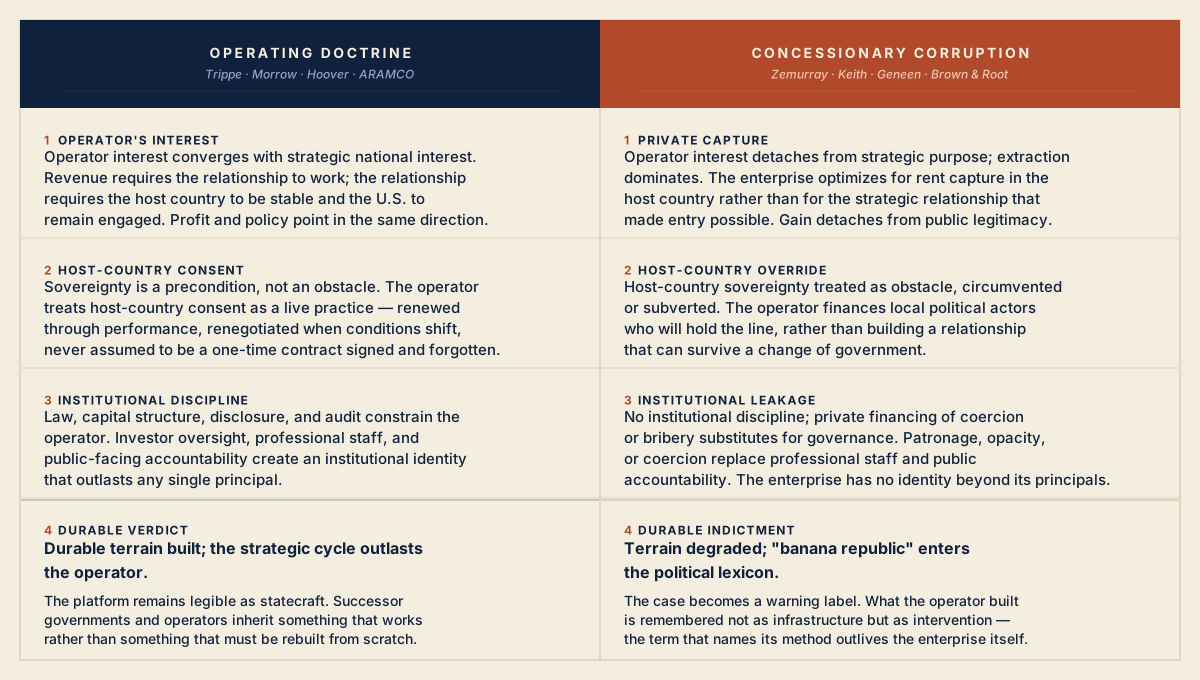
The pre-doctrine policy conversation has missed a figure the doctrine cannot do without, and the figure has gone unnamed for long enough that the language describing it has atrophied. Call the figure the entrepreneur-diplomat: a private builder who creates durable commercial and institutional systems abroad that advance both the enterprise itself and the strategic position of the United States. The entrepreneur-diplomat is not a contractor executing a federal statement of work, not a philanthropist underwriting host-country goodwill, and not a portfolio investor seeking exposure. The entrepreneur-diplomat takes operating risk, deploys long-duration private capital, builds infrastructure on foreign soil, and stays long enough to make an order real. The work proceeds under host-country sovereignty rather than around it. The architecture the operator carries with it is American: legal standards, financial discipline, institutional habits, the things that make an enterprise abroad underwriteable by serious capital and legible to allied counterparties. Profit-seeking and strategic alignment, in this figure, are not in tension. They are constitutively the same project, because the architecture that produces returns is the architecture that produces strategic value.[34]
The figure has the historical antecedents the previous section named in detail. Trippe at Pan Am, the ARAMCO consortium in Saudi Arabia, Astor at the mouth of the Columbia, Morrow as ambassador in Mexico, the pre-presidential Hoover in his engineering practice. Each, in a different industrial register, executed the same operator pattern. The doctrine now needs a contemporary expression of the figure, operating at the scale and on the political terrain the present requires. There are perhaps a dozen American firms in the field today that approximate the type at varying registers. The contemporary cohort is heterogeneous by sector and by operating model. Anduril is building allied autonomous-defense industrial capacity in Australia, Japan, and the United Kingdom under multi-billion-dollar commitments. Last Energy is financing and constructing twenty-megawatt micro-reactors inside Polish and Romanian special economic zones and at the British port of London Gateway under a build-own-operate model. KoBold Metals is operating the Mingomba copper concession in Zambia under State Department coordination. Palantir is embedding command-and-control software into NATO and allied government operations on multi-billion-dollar contracts. Each is doing different operating work in different sectors, with different relationships to the host-country sovereign and different structures of allied integration, and none of the four maps perfectly onto the zone-building, long-duration physical-infrastructure model the doctrine identifies as its core operating unit. That end of the spectrum — private operators building and running special economic zones under host-country sovereignty — is thinner, younger, and less publicly legible than the rest of the cohort, and it is the end the doctrine's core operating unit will have to draw on. The cohort taken together represents a generation of American operators positioning private capital and operating capacity at the strategic terrain the doctrine now needs to engage at scale.[35]
The zone-building end of the field is also where the doctrine's hardest operating lessons already live. Zone operators working under host-country sovereignty have, within the past several years, been tested by the full repertoire of sovereign hostility — constitutional reversal, breach of negotiated stability terms, breach of overlapping treaty protections — and the record of that testing points to a distinction the policy conversation keeps missing: the difference between an enterprise's legal defenses and its operating defenses, and the discovery that the second turn out to come first.
That distinction between operating defenses and legal defenses is worth dwelling on, because it carries the substantive spine of how a Strategic Economic Zone actually survives. Any serious zone faces four operating questions over its life, and the answers are not separable from the doctrine's prospects.
The first question is the alignment of returns and strategy at the level of vehicle design. A zone that hosts operating businesses in sectors the United States is strategically prioritizing, that is capitalized through ordinary American investor discipline, that is anchored to American legal standards and American banking architecture, and that is structured so that the operator's financial discipline and the zone's strategic alignment are produced by the same underlying asset, makes returns and strategy reinforcing rather than competing. A vehicle that begins from a development-finance frame and tries to add returns later, or begins from a commercial frame and tries to add strategic alignment later, almost always fails the test it tried to defer. The architecture that resolves the tension is the same architecture that creates the operating value in the first place.
The second question is sovereignty durability across changes in the host government. The conventional policy answer is legal shields: bilateral treaties, stability clauses, long-duration host-government commitments memorialized in hard-to-unwind instruments. Legal shields matter and should be in place, but they function as the second line of defense rather than the first. The first line is institutional design that makes the zone genuinely useful to the host country: local employment and supply-chain integration, host-country fiscal contribution, visible infrastructure improvements, and operating integration with the host state rather than extraterritorial enclave-building. A zone that is operationally useful enough to its host country is difficult to repeal in practice even if it is easy to repeal in constitutional text. A zone that is not so useful can be repealed in practice with or without the constitutional text.
The third question is host-country consent as a continuous practice rather than as a contract. This is the Morrow frame restated for present conditions. American capital abroad does not survive on the strength of legal instruments alone, but rather on the host country's continuing perception that the capital profits the host nation and is consistent with its own national interest. Walter Lippmann captured the rule in 1927, endorsing a formulation he credited to Morrow in the previous issue of Foreign Affairs: "In the last analysis the security of American investments abroad must rest... on the faith of the borrowing nations. They must believe that American capital profits them, and is consistent with their own national interest."[29] That principle implies a continuous operator practice: working relationships with host-country officials maintained across political cycles, visible commitment to host-country development, operating restraint on questions where host-country sovereignty is particularly sensitive, and good-faith negotiation through adversarial periods. The work is largely unglamorous, off-contract, and not visible from Washington. It is also the work that determines whether a zone survives its first political reversal.
The fourth question is scaling without recapitulating the corruption that doomed the twentieth-century concessionary-commerce pattern. The anti-models named in the previous section are not a historical curiosity. The temptation to convert an operator's leverage in a host country into political interference, asset-extraction concessions, or quasi-sovereign authority over local populations is the structural failure mode that the operator pattern carries with it. The discipline that prevents the failure is partly internal to the operator: investor governance, public-company disclosure norms, professional staff with reputational stakes outside the host country. It is also partly external: host-country consent as a live constraint, allied diplomatic visibility, and statutory architecture in the operator's home country that channels operator behavior toward strategic terrain rather than political extraction. The doctrine's credibility depends on the fact that the operators it now deploys are constitutionally different actors from Zemurray or Geneen, and that the architecture supporting them is constitutionally different from the concession-and-coup pattern of the early twentieth century.
What this implies for the doctrine's next phase is straightforward. The intellectual framework is substantially right and the financial capacity is substantially in place. What is not yet in place at the scale the doctrine's ambitions require is operating capability: principals and firms with the experience, the patience, and the institutional design to build and run zones through the full operating cycle the four questions describe. Recruiting and deploying that capability is the bottleneck. The operators are already in the field. The architecture above them, which the next section describes, is what determines whether they remain a small set of working examples or become the system the doctrine actually needs.
The financial architecture
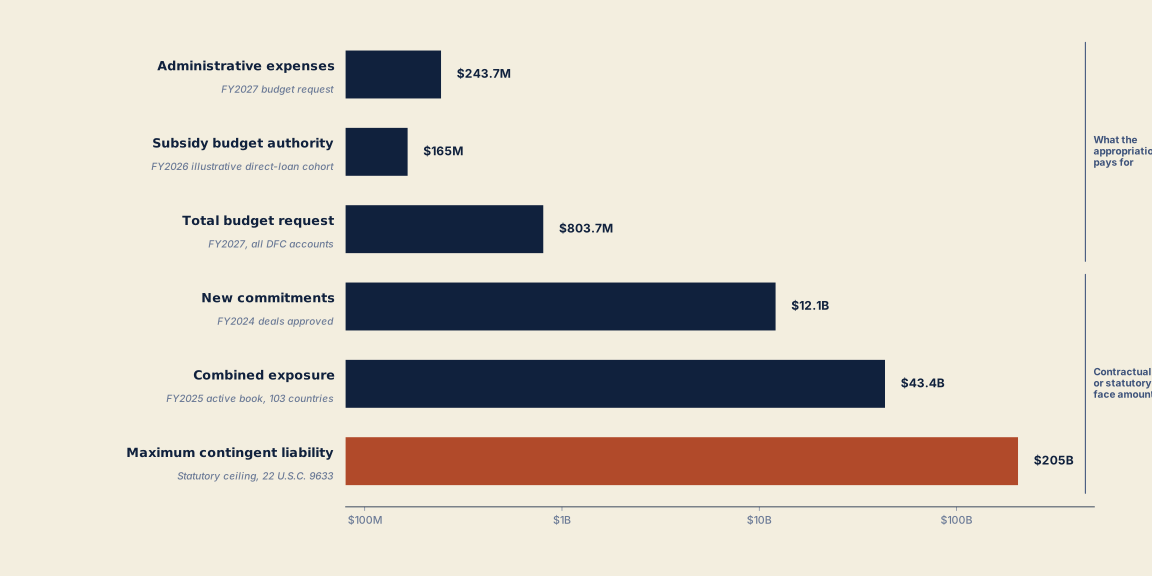
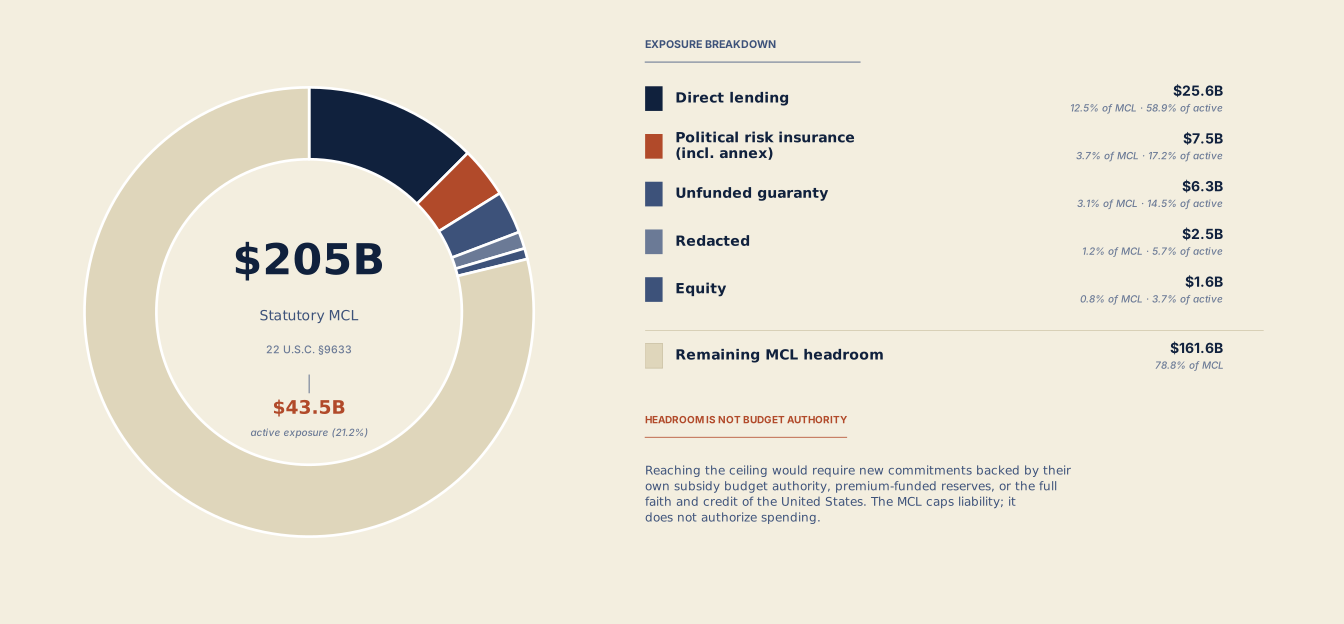
The scaling problem is financial, and Black acknowledged as much in the speech that defined the doctrine. "Simply doing more deals is not a solution," he said in Austin, naming the limit on the doctrine's current tooling almost as plainly as it can be named.[36] DFC's ordinary instruments deployed deal by deal — loans, equity stakes, and project-by-project political risk insurance — saturate the agency's capacity quickly. Each transaction draws against the balance sheet in proportion to its full exposure. Deployed at that rate, the $205 billion of contingent-liability ceiling Congress authorized in the December 2025 NDAA underwrites perhaps a hundred serious strategic projects across the next five years, many of them clustered in a handful of high-profile cases. That is Pax Silica as a series of showcase deals, not as a system.
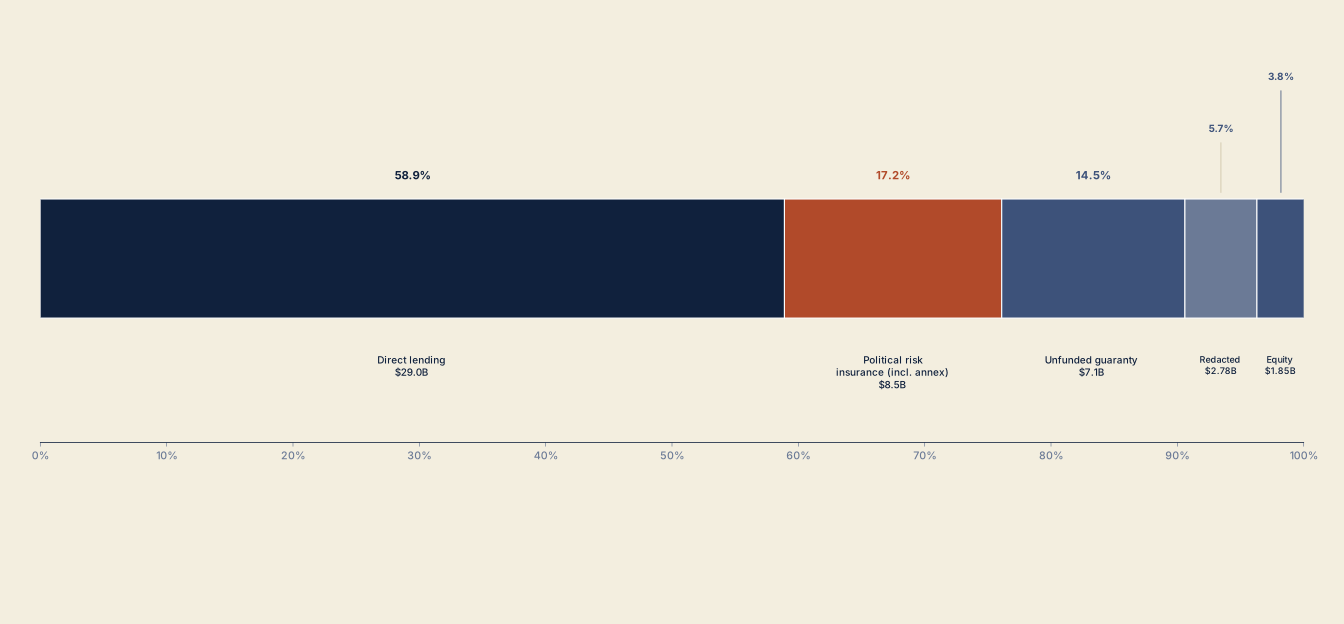
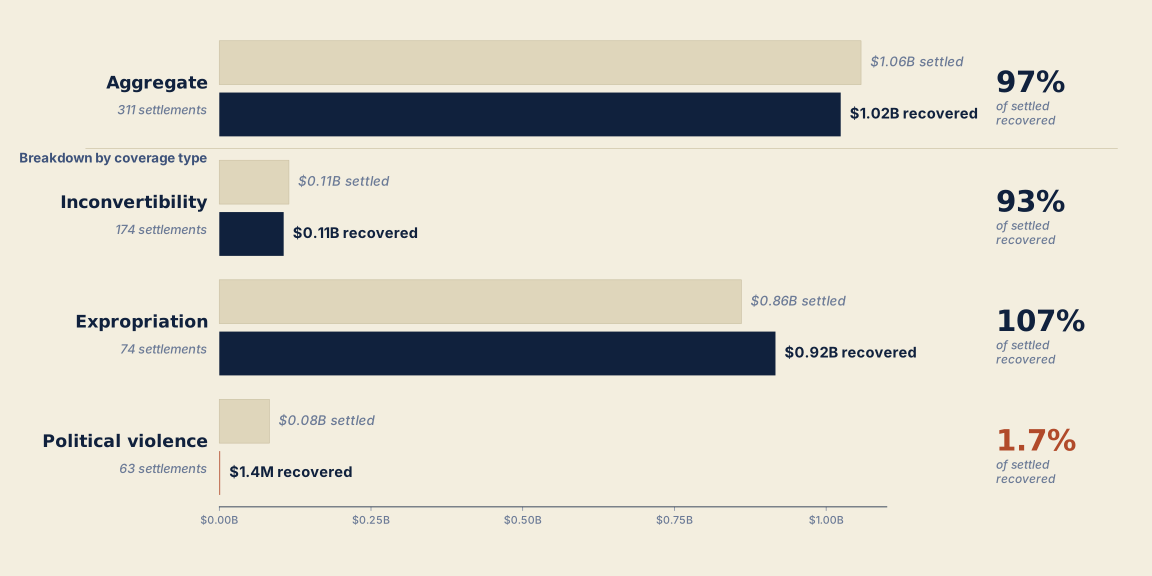
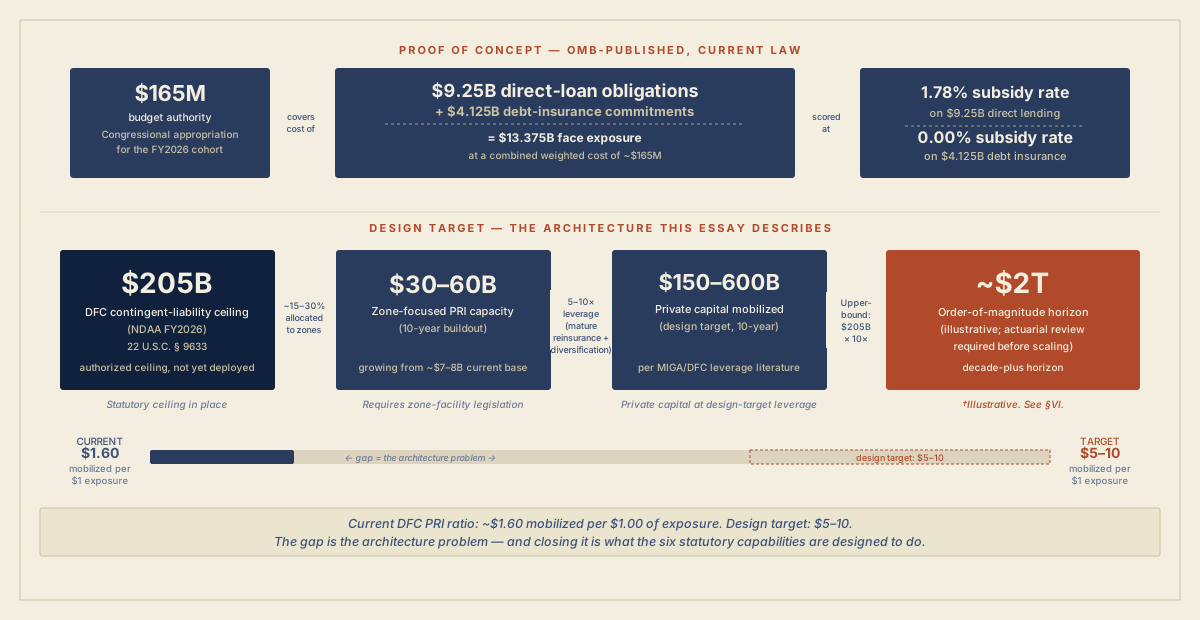
The United States already has the one existing instrument that could in principle back the doctrine with something stronger than diplomacy at the leverage the strategic logic requires: political risk insurance issued by the Development Finance Corporation. The leverage that PRI produces, when the product is well-designed and well-reinsured, is a structural feature of the insurance form rather than a rhetorical claim. The Multilateral Investment Guarantee Agency, the closest international analog to what a serious U.S. zone facility would build, currently carries roughly $36.8 billion of gross guarantee exposure against approximately $2.3 billion of operating capital, accomplishing that ratio by reinsuring 67.7 percent of its gross exposure to private specialty reinsurers and allied official insurers, and holding cumulative losses at 0.8 percent of cumulative gross premium income through fiscal year 2024 and at 2.7 percent through fiscal year 2025, both within the absorption envelope a properly reserved program is designed to carry.[37] DFC's own historical record on PRI is comparably strong on the loss side: a 97 percent aggregate recovery rate on claims paid since 1971, with net positive PRI revenue every year since fiscal year 2020.[5] The aggregate masks a real asymmetry by claim type. Expropriation cases, which dominate the historical book, have generally recovered at or above the amounts paid because contractual rights and arbitral pathways remained intact; political-violence cases, by contrast, recovered roughly $1.4 million on $82.6 million settled, because looted assets in fragile-state environments leave nothing reachable behind the loss.[38] A program designed for strategic-jurisdiction risk has to assume something closer to the political-violence end of the spectrum than to the aggregate, which is part of why the architecture this section describes treats recovery as a constructed feature rather than a residual one. The OMB-side ledger is consistent with the leverage picture: the FY2026 Federal Credit Supplement reports $9.25 billion of DFC direct-loan obligations at a 1.78 percent subsidy rate, about $165 million of budget authority for the cohort, alongside $4.125 billion of debt-insurance commitments scored at zero.[39] The Federal Credit Reform Act covers those debt instruments cleanly. How OMB and CBO will score a non-debt PRI sleeve, or a reinsurance sleeve sitting on top of one, is a question still in front of the budget offices, and one the architecture this section describes will have to put to them in writing before any program scales. The leverage the international PRI literature documents in well-designed programs runs in the range of five to ten dollars of private investment for every dollar of properly reserved coverage. A 2023 DFC and McKinsey impact assessment of fourteen PRI transactions, representing roughly 30 percent of DFC's active PRI maximum contingent liability at the time, found about $1.60 in directly mobilized private capital per dollar of PRI exposure across the sample. That ratio reflects the agency's concentration in challenging frontier markets and the absence of the diversification and reinsurance depth a mature program would provide, and the gap between it and the design target is the financial-architecture problem this section names.[40]
That leverage is a theoretical possibility today and an operational reality only if the underlying product does the job a Strategic Economic Zone actually requires. It does not currently. Running a zone through the full political-risk life cycle, as the operator field cases show in concrete form, surfaces four specific failures in conventional PRI as a coverage product for the doctrine's purposes.
Four structural failures in conventional PRI
Coverage scope
Book value is too small
Zone risk is enterprise destruction, not only invested capital.
Absent consequence
Claims do not deter
Subrogated recovery lacks automatic sovereign penalty.
Throughput
Federal cadence is too slow
Deal-by-deal underwriting mismatches commercial speed.
Durability
Agency discretion is unstable
Twenty-year zones need statutory identity.
The problem is structural, not operational. More deals do not fix architecture.
The first failure is coverage scope. The asset at risk in a zone is not the invested capital alone. It is the operating enterprise as a going concern, including the legal architecture, the resident base, the operating businesses, the infrastructure buildout, and the institutional relationships that take years to construct. Conventional PRI compensates against book value. It does not capture enterprise destruction. A zone operator facing a hostile government action that degrades the operating environment without formally expropriating it cannot recover the going-concern value the action destroyed. PRI as currently structured insures yesterday's risks and yesterday's framework for valuing them, not today's.
The second failure is the absence of automatic consequence. When a conventional PRI policy pays out, the insurer takes an assigned claim against the host government and pursues subrogated recovery through ordinary legal channels. That works for garden-variety political-risk cases. It does not work when the host government has made a political decision to repeal or repossess a zone framework, because political decisions of that scale are not reversed by ordinary recovery pressure. Expropriation today carries paperwork, not consequences.
The third failure is throughput. Federal underwriting moves at the wrong tempo for a system that needs to deploy hundreds of billions of dollars of private capital at the speed of contemporary commerce. Capital moves at the speed of business, with project timelines measured in weeks to a few months. Federal underwriting moves in quarters to years. That cadence was acceptable when the relevant programs began with the Marshall Plan. It is not acceptable in a competitive environment where adversary state capital deploys in our hemisphere within weeks.
The fourth failure is durability. A zone operator making a twenty-year or longer infrastructure commitment cares whether the program backing the coverage survives a change in administration, because the operating life of a zone is longer than any U.S. political cycle. PRI as currently authorized lives within program parameters that can be adjusted at agency discretion under future leadership. Statutory identity that outlasts any single CEO, Board, or administration is the categorical change. Without it, the program runs on goodwill, and goodwill is the variable that fluctuates when political winds shift.
These failures are structural rather than operational. What solves them is a complete statutory architecture composed of six interlocking capabilities, each addressing a specific failure and together producing a system that designates, binds, protects, scales, collects, and deters as a single operating whole.
The American Investment Shield
Designate
Screen zones for strategic fit
Bind
Accession terms and waivers
Protect
Full-value investment insurance
Scale
Delegated issuance at speed
Recover
Pre-identified assets and claims
Deter
Mandatory consequence framework
Six capabilities turn PRI from a payout product into an operating system.
The first capability is designation. There are roughly seven thousand special economic zones in the world today, and most of them should never be inside an American framework. The zones that should be inside it are identifiable by an articulable screen: common-law commercial DNA, regulatory reciprocity with the United States, durable institutional design, structural exclusion of adversary participation rather than rhetorical exclusion, and a written recovery-feasibility finding before coverage is ever extended. Designation is the act that determines whether American capital concentrates in zones that compound American advantage or scatters across zones that do not.
The second capability is full-value investment insurance. Coverage written at the going-concern level rather than the book-value level, reaching enterprise value, business interruption, debt service, intellectual property expropriation, state-directed cyber action against zone operations, and personnel coercion of zone residents and employees. Coverage written on hard statutory deadlines for claim payment, with emergency interim-payment authority for cases that cannot wait through a multi-year arbitration. The contemporary forms of expropriation that conventional coverage does not reach are precisely the forms the doctrine's operating environment surfaces.
The third capability is delegated issuance at scale. Once a jurisdiction is certified, qualified zone operators should be empowered by an umbrella political-risk-insurance policy from which they issue project-level coverage under federal standards. A single zone designation should unlock coverage for hundreds of underlying investments without re-running federal underwriting on each one, with deemed-approval timelines and full federal audit access as the discipline that makes delegation safe. This is the architectural answer to the throughput failure. The architectural pieces for it are already in operation at smaller scale across U.S. and multilateral practice. OPIC's private-equity-fund insurance facility used a Framework Agreement plus Master Insurance and Reinsurance Policies plus Project Annexes to issue coverage on portfolio companies up to $250 million per fund investment without re-underwriting at the project level. EXIM in 2018 transferred roughly $1 billion of loss coverage on part of its aircraft portfolio to private specialty reinsurers under existing authority and explicit charter language directing the agency to minimize taxpayer exposure. MIGA's IDA Private Sector Window operates a guarantee facility with cession caps at 90 percent of any individual project and 70 percent of aggregate gross exposure, the shape of guardrail a zone-focused umbrella would inherit.[41] None of this is invention. It is configuration.
The fourth capability is a binding accession instrument. Allied governments cannot meaningfully secure American capital at scale through declarations alone. The framework's spine is an accession-based agreement, structurally similar to the WTO accession protocols or the OECD anti-bribery convention, through which any qualifying partner country signs a single text on standardized terms. Those terms include waivers of sovereign immunity for suit, execution, and prejudgment attachment that make U.S. recovery against a hostile sovereign actually enforceable. In exchange, the framework's protections extend to the partner country's certified zones, and the partner shares in the upside of the platform built on its soil.
The fifth capability is recovery architecture. When a host government breaches, the program's response cannot be a back-office subrogation function that takes a decade to produce results. A deterrent only deters if the political actors considering hostile action against US businesses can be reasonably confident they will face the consequences quickly enough to change their political calculus.
The architecture pre-identifies host-country assets reachable through U.S. legal process before coverage is written, mandates Treasury asset freeze on claim payment, supplies anti-suit injunction authority where appropriate, sets a recovery target meaningfully above the amount paid (the working figure is three times the claim), and shares the upside of recovery with the U.S. taxpayer through equity participation, revenue sharing on resumed operations, and a structured split of recovery proceeds.
The sixth capability is a mandatory consequence framework. The program needs a statutory architecture that converts the payment of a claim into a mandatory federal response across financial, trade, and personnel categories drawn from a defined menu, with at least one measure required from each category. Without that mandatory framework, the response to expropriation of an American zone operator is whatever the administration in office happens to choose, and an adversary can rationally bet that the choice will be modest. With it, expropriation becomes the most expensive mistake a host government can make, and the deterrence effect compounds across the entire zone portfolio rather than depending on the political appetite of any given administration.
The math the architecture produces is forward-looking and conditional, structured as scenario analysis rather than as a current-portfolio extrapolation. Under the leverage ratios well-designed PRI has historically achieved, a zone-focused facility that grows from the current seven-to-eight billion dollars of active DFC PRI exposure to roughly thirty-to-sixty billion dollars of allocated capacity over a decade, with mature reinsurance arrangements and the diversification across host countries and sectors that an accession framework would support, would anchor in the range of $150 billion to $600 billion of private investment over the same period. At the upper bound of authority and architecture, with allied official co-insurance fully institutionalized and the consequence framework producing the deterrent effect designed into it, the order of magnitude over a decade-plus horizon reaches into the trillions. The gap between the current ratio of roughly $1.60 of mobilized capital per dollar of DFC PRI exposure and the design target contemplated here of five-to-ten dollars is precisely the gap the six capabilities are intended to close.[42]
Some of the work can begin under existing BUILD Act authority and does not require Congress to act first. DFC can stand up a dedicated zone-focused facility within roughly nine months of a Board decision to proceed, with standardized documentation, committed staff, published underwriting criteria, and the first coverage written on a designated pilot zone in the Western Hemisphere. The facility can pair PRI with DFC's existing minority equity authority, layer reinsurance from private specialty markets and allied official insurers, and develop the actuarial loss data on which the broader program would be built.
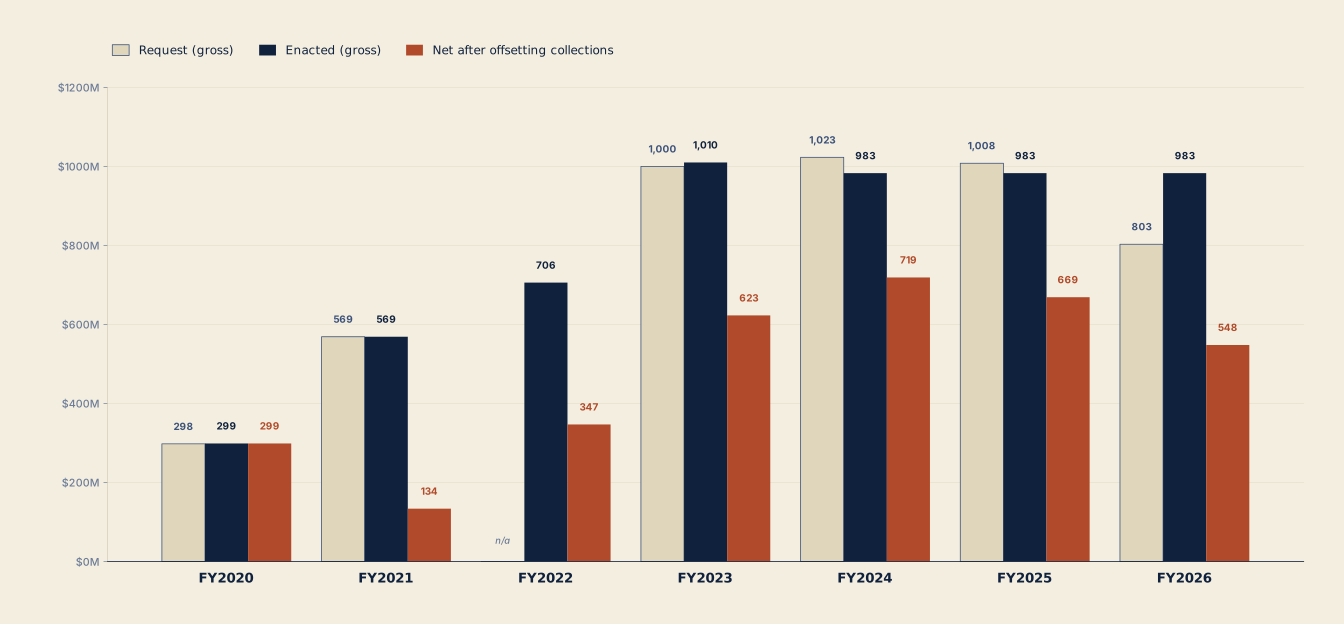
What the facility cannot accomplish under existing law is the categorical change in the four failure dimensions: full enterprise-value compensation, statutorily mandated claim-processing deadlines, sovereign-immunity waivers that make recovery enforceable, automatic interagency consequence on payment, and the long-duration statutory identity that survives administration cycles. Those require Congress. A legislative framework that addresses all four in a single coherent statute is the second track. Running the two in parallel compresses what might otherwise be a years-long sequence and lets the statutory work proceed against working examples rather than theoretical proposals.
The doctrine the administration has articulated already has the capital base, the coalition, and the operating principals required to do the work. What it lacks at scale is the financial architecture that converts those three inputs into investment volume. The architecture is specifiable now. The first pieces can be built under current authority. The full system requires Congress to act, and the action required is structural rather than rhetorical. The doctrine will become a series of cases, or it will become a system. The financial architecture is the difference.
The objections
A doctrine claiming the ground this one claims has to absorb honest critique from the schools that have done the most thinking about adjacent problems. Five schools deserve direct engagement, on the strongest version of their critique rather than the easiest. Each is engaged below, and a hinge formulation is offered against each that the doctrine should keep visible in any external setting.
The first school is the engagement and liberal-internationalist tradition: John Ikenberry, Richard Haass, Tom Wright, Anne-Marie Slaughter, William Burns, and the recent and immediately consequential critique from Vanda Felbab-Brown at Brookings. The hardest version of the critique is governance equity. Strategic Economic Zones produce real economic benefit for the host state and real strategic benefit for the United States, but they may produce a governance asymmetry in which the host state gains commercial activity and fiscal contribution while the United States gains operating leverage that the host political system has limited durable voice in shaping. The Felbab-Brown variant sharpens the critique by pointing at the precedent the model risks setting in regions where extraterritorial commercial arrangements carry a difficult historical memory.[43]
The doctrine described here is specifically designed to address this critique. A binding accession instrument that gives host countries a co-governance structure, with formal voice in the standards governing the framework's protections, in the criteria for designation, and in the standards for adversary exclusion, addresses the governance-equity concern at the level the critique operates on. Statutory architecture, rather than executive-discretionary PRI, addresses the secondary concern about the durability of American commitments to host countries that have invested political capital in the framework. The hinge formulation here is plain: operators do not replace the state; they execute under a publicly specified charter, and the charter is jointly specified with the host country through accession.
The historical-memory variant of the Felbab-Brown critique deserves a more direct answer than co-governance language alone provides, because the names that produced the difficult memory in this hemisphere, Zemurray and Keith most prominently, are precisely the names the doctrine has to be constitutionally distinguishable from rather than merely rhetorically separated from. Three layers do that work, and they operate in combination.
The first layer is statutory. The categories of conduct that produced the early-twentieth-century pattern are now criminally prohibited under federal law through a layered statutory framework that did not exist in 1911. The Neutrality Act prohibits the financing or conduct of unauthorized military expeditions against nations with which the United States is at peace, which is the statute that most directly reaches the Zemurray pattern itself. The Foreign Agents Registration Act requires public disclosure of any agent acting on behalf of foreign principals to influence U.S. or foreign policy. The Arms Export Control Act and the International Traffic in Arms Regulations regulate the export of defense articles and services to foreign actors. The International Emergency Economic Powers Act and the Office of Foreign Assets Control regime authorize criminal sanctions against transactions with designated foreign actors. The Foreign Corrupt Practices Act criminalizes bribery of foreign officials. The Bank Secrecy Act and the Anti-Money Laundering Act of 2020 impose continuing reporting obligations on the financial flows that funded the historical pattern. What Zemurray did in 1911, financing a private paramilitary expedition that overthrew a sitting government, would today be prosecuted at multiple points in the statutory sequence as a federal felony, and the institutional infrastructure for that prosecution did not exist when the historical anti-models operated.[44]
The second layer of defense against this critique is financial and institutional in nature. The capital base that funds modern strategic operators (institutional investors, public-company governance, public-company disclosure norms, infrastructure-scale lenders) imposes governance friction against the early-twentieth-century pattern, because the category of conduct that produced it sits poorly with the disclosure and reputational regimes large institutional capital now operates within. The friction is not absolute. Capital has flowed into extractive operations in fragile-state environments under modern governance regimes, and the historical record on private equity in adverse jurisdictions is mixed. The structural layer is therefore one input among several into the cost calculus a modern operator would face attempting the historical pattern, not a guarantee against it.
The third layer is architectural. The certification, audit, and consequence framework the doctrine specifies makes operator conduct legible to U.S. enforcement and host-country counterparties on a continuing basis, with the federal government retaining audit access at any time and certification revocable on adverse finding. The Zemurray pattern requires the absence of all three layers to recur. The architecture under construction supplies all three. The historical anti-models are part of why the architecture is structured the way it is, not the reason to refuse the doctrine the architecture is built to support.
The second school is the restraint and realist tradition: Stephen Walt, Stephen Wertheim, Andy Sankaran at the Quincy Institute, John Mearsheimer, Suzanne Werner, and the more recent contributions from Emma Ashford and Jennifer Kavanagh. The hardest version of the critique is the commitment-expansion trap. Every certified Strategic Economic Zone is a node, and every node creates a threat surface that, if breached or threatened, implicates American credibility. A doctrine that builds dozens of zones across allied geographies is, on the realist account, building dozens of new commitments the United States may eventually be called upon to defend with means it would prefer not to deploy.[45]
The doctrine's answer rests on the architecture of the framework itself. The Pax Silica coalition is voluntary and incentive-based; certification is opt-in; the consequence framework attaches to economic and trade measures rather than to military posture as a first response. The doctrine's orientation is constructive rather than denial-oriented. It builds allied terrain rather than seeking to close adversary terrain through commitments that escalate readily. The hinge formulation belongs here: hemisphere primacy is a claim about sequencing and resilience rather than sovereignty and exclusion, and the doctrine seeks to reduce the military demand signal by improving governance, growth, and supply resilience, not to create new military equities for every strategic commercial node. The realist concern is real, and it produces a useful discipline: the framework should resist the temptation to militarize at the first sign of strain.
The sharper version of the realist critique focuses on the mandatory consequence framework itself, and deserves a sharper answer. The framework is, intentionally, an instrument the United States cannot easily back away from once it is in place. That irreversibility is the feature, not the failure mode. The closest existing parallel is the modern statutory sanctions architecture: the Countering America's Adversaries Through Sanctions Act mandatory-sanctions provisions on Russia, Iran, and North Korea; the secondary-sanctions regime developed under the Iran Sanctions Act and the Comprehensive Iran Sanctions, Accountability, and Divestment Act; and the Specially Designated Nationals framework administered by the Office of Foreign Assets Control under the International Emergency Economic Powers Act. In each of those cases, Congress wrote a statutory framework that imposes mandatory consequences on counterparties for crossing defined lines, with limited executive discretion to walk away once a trigger is met, and Congress did so precisely because Congress did not trust the executive branch to maintain credible deterrence under political pressure. The architecture has demonstrably reshaped the behavior of sovereign actors who are not formal U.S. allies and who would prefer to behave otherwise, and it has been enforced through three administrations of opposing parties.[46] The mandatory consequence framework that backs Strategic Economic Zones is structurally similar to that architecture and operates on the same logic. Yes, the framework binds the United States too. That is precisely why it deters.
The deeper realist question, the one about whether the United States should be expanding strategic commitments at all in the present environment, runs through a frame the doctrine has to make explicit. The alternative to constructive economic engagement at scale is competition under terms in which a peer adversary deploys state capital backed by direct sovereign-to-sovereign bargaining and, where useful, by bribery and corruption that American firms cannot legally match. The Foreign Corrupt Practices Act and the Logan Act are vigorously enforced and apply without exception to American firms operating abroad; what the comparator does, an American operator may not do, full stop. Architected deterrence backed by U.S. instruments and operating under host-country consent through accession is the only path through which American capital can compete in the geographies where the contest now operates without either ceding the ground or operating illegally. The realist case for restraint, in the present competitive environment, is also the case for losing the field.
The third school is the free-trade orthodoxy: Adam Posen at the Peterson Institute, Lawrence Summers, Scott Lincicome at Cato, Douglas Irwin, John Cochrane at Hoover and Stanford, and the more recent contributions from William Reinsch at CSIS. The school has many critiques; the strongest single one is Cochrane's transparency test. Any program that creates contingent federal liabilities for the benefit of private actors, the argument runs, must be scored on-budget by the Congressional Budget Office, with the contingent liabilities visible to the appropriations process and the resulting fiscal exposure properly disclosed. Anything else is hidden subsidy, and hidden subsidy distorts capital allocation while concealing taxpayer risk.[47]
The doctrine accepts the test and embraces it. Certified-zone insurance should be scored on-budget by CBO. The contingent liabilities of the mandatory consequence framework should be disclosed explicitly. The premium structure should be designed to cover expected losses on an actuarial basis. None of this is a concession to the critique. It is a strengthening of the doctrine, because a program that survives transparency is categorically more durable than a program that hides exposure. The Cochrane school is a friend of the doctrine when the framing is right, because it presses for exactly the design discipline a serious operating program needs to maintain over the multi-decade horizons the architecture envisions.
Federal contingent-liability transparency is a regime the United States already runs at scale on the domestic side. The Federal Deposit Insurance Corporation insures roughly $10.66 trillion in domestic deposits on a $2.5 billion operating budget, without congressional appropriations, funded entirely through assessments on insured banks. The Federal Housing Administration's Mutual Mortgage Insurance Fund insures around $1.6 trillion in active forward-mortgage principal on a $160 million administrative request, generating $9.4 billion in projected negative subsidy receipts to its capital reserve account. The Export-Import Bank carries about $34.8 billion in active exposure against a $135 billion statutory cap.[48] What the doctrine proposes is the extension of a budget-and-disclosure logic the United States already operates for housing, banking, and trade finance to a strategic geography it has so far been unwilling to underwrite at comparable scale. Cochrane's transparency test is the operating manual for that extension, not a barrier to it.
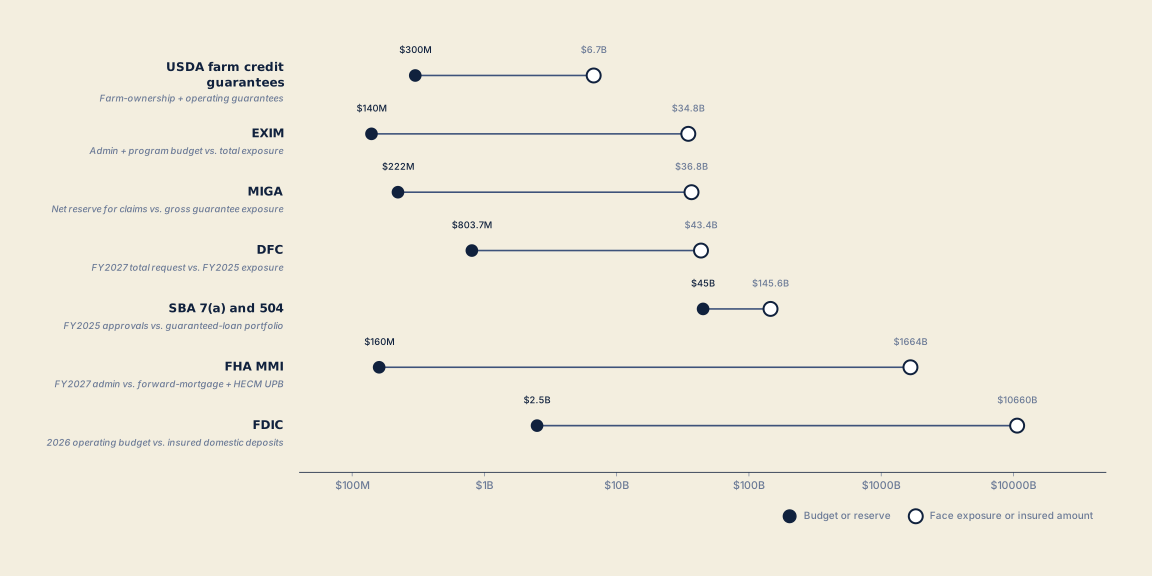
The fourth school is the new right and national-conservative tradition: J.D. Vance, Oren Cass, Sohrab Ahmari, Peter Navarro, Patrick Deneen, and the more recent contributions from Michael Lind. The hardest version of the critique is Cass's reciprocity argument: the doctrine, at its core, still lets American capital route around national political control by deploying it abroad rather than rebuilding domestic productive capacity. From the new-right vantage, foreign-deployed industrial capacity is industrial capacity that escapes domestic political accountability, and the doctrine therefore continues, in modified form, the globalist pattern that the new right was constituted to oppose.[49]
The doctrine engages the critique on three points. Strategic Economic Zones are the foreign-theater complement to domestic reshoring, not its substitute. The doctrine does not propose to relocate American industrial capacity abroad; it proposes to build allied capacity that compounds American strategic position in geographies where domestic production cannot reach. Both halves are needed and both are weaker without the other. The adversary-exclusion architecture distinguishes the doctrine sharply from globalist free trade, because capital deployed under the framework is structurally constrained from drifting toward adversary state-capital cooperation through the certification screen and the ongoing audit access that make the constraint enforceable. And the statutory framework places operators under public law through certification, accession, and consequence, rather than beside public law through unmediated commercial activity. The doctrine is the form of capital deployment most compatible with the new right's underlying critique of unaccountable globalist commerce, which is why a serious version of the engagement is more productive than reflexive opposition. The hinge formulation: reciprocity matters, but reciprocity without consent in neighboring societies becomes simple domination, and domination is strategically self-defeating in the Americas.
The fifth school is heterodox geoeconomics: Brad Setser at the Council on Foreign Relations, Paul Tucker, and Dani Rodrik. The hardest version of the critique is Rodrik's local-productive-transformation test. Zones, the argument runs, are acceptable economic-statecraft instruments only if they demonstrably thicken the host country's productive ecosystem rather than operating as enclaves whose benefits are extracted to the home country of the capital. The criterion is not equality of returns; it is local linkage, supply-chain participation, skills transfer, fiscal contribution, and infrastructure spillovers that compound the host country's own economic capacity.[50]
The doctrine answers the test by pointing at the host-country consent practice described in Section V and at the four operating disciplines that flow from it: local employment and supply-chain integration, host-country fiscal contribution, visible infrastructure improvements, and operating integration with the host state rather than extraterritorial enclave-building. Those four disciplines are not slogans. They are operating design principles the field cases test in real time, and a zone that fails them is structurally vulnerable to repeal regardless of the legal protection it carries. The doctrine accepts Rodrik's criterion as the right one. It maintains that the operating practice of well-designed zones meets it, and that meeting it is part of what makes the architecture sustainable.
Two further critiques deserve acknowledgment but engage different programs. Drezner's coercive-tools academic frame describes a different lane of economic statecraft and is engaged in Section II rather than as an objection to the doctrine itself. Yoram Hazony's legal-empire critique misreads what consent-based jurisdiction is doing; the framework the doctrine builds is constitutionally different from the empire model the critique has in view, and the critique therefore lands on a different doctrine than the one this essay describes.
The hinge formulations carry across the engagement. Hemisphere primacy is a claim about sequencing and resilience rather than sovereignty and exclusion. Pax Silica is a coalition architecture for productive depth rather than a digital sphere of influence. Operators do not replace the state; they execute under a publicly specified charter, jointly specified with the host country through accession. Reciprocity matters, but reciprocity without consent in neighboring societies becomes simple domination, and domination is strategically self-defeating in the Americas. The doctrine seeks to reduce the military demand signal by improving governance, growth, and supply resilience rather than to create new military equities for every strategic commercial node.
The choice
The doctrine the administration has articulated will become a series of cases or a system. The difference is the financial architecture this essay has described and the operators to deploy it. The two are inseparable. Capital without operating capability produces speeches and showcase deals. Operating capability without scaled financial architecture produces a small set of working examples that cannot become a program.
The operators are already in the field. Anduril is building allied autonomous-defense capacity in Australia under a five-year A$1.7 billion Ghost Shark program for the Royal Australian Navy, a 7,400-square-meter Sydney manufacturing facility opened in 2025, and parallel industrial commitments in the United Kingdom and Japan. Last Energy is operating on a build-own-operate microreactor model that places twenty-megawatt units inside Polish and Romanian special economic zones and at the British port of London Gateway under an £80 million investment, with a NATO Energy Security Centre of Excellence partnership running alongside. KoBold Metals is operating the Mingomba copper concession in Zambia under State Department coordination, with the Lobito Trans-Africa Corridor positioning that follows it. Palantir is running the Maven Smart System as a Pentagon program of record and as a NATO-wide product, under a £1.5 billion United Kingdom strategic partnership announced in 2025. And at the zone-building end of the field, operators have been running special economic zones under host-country sovereignty through hostile political cycles — including reversals that, on the conventional account, should have ended their operating lives.[51]
The Western Hemisphere is the theater where the doctrine should be proved at scale first, which is a claim about sequencing rather than about scope. The doctrine's ambition is global; the Pax Silica framework was designed precisely to anchor the Indo-Pacific theater, and the financial architecture this essay describes is meant to operate across the full allied geography the framework reaches. Sequencing is a question of which prototype proves itself fastest. The Hemisphere offers the cleanest first proof. The cost of entry is lower than in the Indo-Pacific. The logistics are shorter. CAFTA-DR, the existing bilateral investment treaty network, and the legal familiarity American counsel already possesses give the underwriting architecture a starting point that the Indo-Pacific does not yet match. The strategic case for nearshoring, for supply-chain resilience, for critical-minerals processing outside adversary reach, and for reducing the push factors behind irregular migration all run through the Hemisphere. And the Hemisphere already has zone-operating experience that has been tested through the kind of political reversal the doctrine's critics have not yet imagined and the doctrine's supporters have not yet had to defend. One or two Hemisphere zones moving from pilot to full operation within the next eighteen months would do more for the doctrine's credibility than any number of corridor speeches or coalition communiques. The Indo-Pacific buildout follows the architecture the Hemisphere prototype establishes, not the other way around.
The choice in front of Congress and the administration is straightforward. The doctrine, the coalition, and the capital base are in place. The operators are in the field. The financial architecture is specifiable now and partly executable under existing authority, with the remainder requiring statute. American economic statecraft will become a series of speeches and showcase deals if the missing pieces are not built, and it will become the system its strategic logic requires if they are. Both outcomes remain available. The interval in which both remain available is not unlimited.
Developments since first publication
This section was added in August 2026. Apart from the corrections described in the editor's note, the essay above stands as first published.
This essay was filed in early May describing a doctrine that had been articulated, a coalition that had been assembled, and an architecture that had not been built. Three months later the articulation has hardened into a name, the coalition has roughly doubled and arrived in the Western Hemisphere, the first program competition has opened, and the first Economic Security Zone has run precisely into the two binding constraints Section III named.
On May 29, Treasury Secretary Scott Bessent told the Reagan National Economic Forum that "somewhere along the way, we lost sight of a foundational principle that previous generations understood instinctively: economic security is national security, for a nation that cannot manufacture, mine, ship, or refine its needs gradually cedes its strength—and sovereignty—to others."[52] Then, on June 23, he delivered an address at the Economic Club of New York under the title "American Economic Statecraft in the 21st Century," and supplied the definition in a single sentence: "So tonight, I would like to take the next step and describe our strategy for economic statecraft, by which I mean the disciplined use of America's economic power in service of our sovereignty."[53] When this essay was filed, American economic statecraft was a description assembled from the administration's practice — a doctrine legible in its speeches but not yet named by its principals as a settled frame. Now, the administration has explicitly defined the doctrine.
The doctrine also entered the congressional record. In written testimony to the Senate Foreign Relations Committee on June 2, Secretary of State Marco Rubio stated the doctrine's aid-to-investment inversion as policy: "That is why our new model emphasizes trade over aid, investment over dependency, and mutually beneficial partnership over permanent patronage." The same testimony carried the integration thesis discussed above: "foreign policy cannot be separated from economic policy, border policy, energy policy, or any other sphere. A country that cannot build ships, produce medicine, control immigration, or access vital resources cannot defend its people, its interests, or its way of life."[54] The following day, before the House Foreign Affairs Committee, the Secretary described the Pax Silica coalition and the economic security zone taking shape on former U.S. base land in the Philippines.[55]
Perhaps more important than what Secretary Bessent and Secretary Rubio said are the things they didn't say. Neither cabinet member named a standing financing and enforcement framework behind the coalition and its zones. The only place the written testimony reaches for a financing vehicle at all is a gesture at "programs like" the America First Opportunity Fund, a discretionary account.[54] This is not meant as a criticism of the Secretaries; far from it. They're doing what they can with the tools they have. The problem with the doctrine is the tools it's missing.
Congress, for its part, has begun examining the operating unit directly. On July 14, the House Foreign Affairs Subcommittee on Oversight and Intelligence held the first congressional hearing devoted to Economic Security Zones as an instrument — "U.S. Economic Security and Investment Abroad: Assessing Economic Security Zones" — with a witness table that ran from a zone operator through a critical-minerals processor and an infrastructure exporter to a skeptic from the Cato Institute.[56] The testimony converged on the essay's first binding constraint from every side of the table. The operator, Próspera's chief executive, told the subcommittee that "political risk is the one risk that private capital cannot solve for itself."[56] A critical-minerals executive testified that political risk insurance must "survive administrations, both here and there."[56] And the infrastructure exporter, Acrow's Paul Sullivan, reported the answer American firms now hear from foreign governments: "the political risk is not us, it's you" — the inversion in which the durability of American programs, not the conduct of the host, is the risk being priced.[56] The day after, at the full committee's hearing on supply-chain dependency, Chairman Brian Mast named the U.S. International Development Finance Corporation, the U.S. Trade and Development Agency, and the Millennium Challenge Corporation "among our most important tools of economic statecraft."[57]
The coalition, meanwhile, grew. At the second Pax Silica summit in Washington on June 25–26, the Declaration added ten partners, bringing it to twenty-four signatories in six months, among them the framework's first Western Hemisphere members: Panama, Costa Rica, El Salvador, Argentina, and Chile.[58] A separate, larger declaration on AI opportunity drew roughly thirty-five signing countries at the same summit; the two counts describe different instruments and should not be merged.[62] Under Secretary Jacob Helberg announced the framework's first program at the same summit (a trade-facilitation and credentialing platform for trusted shipments, launching through Panama) with the State Department "working with Congress to commit $50 million in foreign assistance funding dedicated to the development and deployment of Pax Pass. We are putting our resources behind our vision and demonstrating that trusted partnership is backed by real investment."[59] In July the State Department posted the first solicitation under that announcement: a funding opportunity of approximately fifty million dollars to build AI-assisted customs screening and trusted-shipper infrastructure, Panama first, anticipating one to three cooperative agreements, subject to the availability of funds, with applications due August 20. A notice of funding opportunity is not an award, and as of this writing no award has been made, but it is the first executed solicitation in the framework's history, and it gives the doctrine a program design, an application path, and an implementation timetable.[60] Accessions have continued since: the State Department described Italy's July 31 accession as the framework's twenty-fifth.[61]
Two things follow from these developments. The first is sequencing: the framework designed to anchor the Indo-Pacific has placed its first program competition in the Western Hemisphere, through the jurisdiction where — as the State Department's senior official for the hemisphere told the Senate on July 14 — the United States is backing a partner "as China conducts economic retaliation and seeks to undermine the rule of law in Panama following the decision by Panama's independent Supreme Court regarding the Balboa and Cristóbal ports."[63] Section VIII's claim that the hemisphere offers the doctrine its fastest proof is no longer only this essay's argument. The second is structural: the December Declaration committed no funds and bound no signatory. A coalition that is beginning to confer benefits worth keeping is a different kind of coalition, one whose standards can begin to carry consequences, and one for which the accession architecture Section III described stops being hypothetical and becomes the obvious next instrument.
Unfortunately, the failure modes this essay predicted are also coming to fruition. The Luzon Economic Security Zone, which is the framework's first physical node, announced in April, spent the summer demonstrating what happens when doctrine reaches the ground ahead of its architecture. The terms under discussion in May included governance under U.S. common law and treatment of the site as diplomatic property, protections comparable to diplomatic immunity.[64] The host government refused.
"That's their request, but we did not agree to that," said Joshua Bingcang, president of the Philippines' Bases Conversion and Development Authority, when asked about the reported terms. "There will be no special arrangement accorded to the US," he added. The zone, he said, would be treated as a regular business development contract under ordinary Philippine law.[64] As of mid-July the long-term framework remained unsigned, with the parties exchanging drafts toward a possible signing at the November ASEAN summit, and the American development-finance support reported so far was funding for a feasibility study.[65]
The project has also drawn scrutiny inside the Philippines: lawmakers sought a House inquiry in late July over land use, consultation, and terms, and a senator filed a resolution seeking a Senate inquiry in early August. The development authority welcomed the oversight and said the project would support rather than displace affected communities, and the government separately disputed claims that farmers would be removed. Those claims remain contested, and the inquiries remain unresolved, which is a stark reminder that host-country consent runs deeper than the signature of the government of the day.[66]
Read carelessly, Luzon is a setback. Read carefully, it is Section III of this essay observed under field conditions; the exact failure mode we predicted happening right after we predicted it. Absent a standing, ratifiable instrument, officials on both sides improvised: the protections American capital requires were assembled ad hoc in a bilateral negotiation, the improvisation pressed directly against host sovereignty, and the host declined it publicly. Nothing about the episode discredits the zone concept; the Philippine government still wants the zone, and Helberg stated the underlying requirement in May: "Investors who are going to spend billions of dollars to build out very expensive capex need to make sure that those investments need to outlive administrations in both of our countries and there needs to be an element of durability and certainty."[67]
What this episode prices is the missing architecture. An operating environment has to be constructed under host sovereignty, through an instrument the host's own constitutional process can ratify and its own politicians can defend. That is what the accession framework described in Sections III and VI exists to be. The difference between an announcement and an investable commitment is now measurable in the months between April's press release and November's hoped-for signing.
The doctrine now has a full name and definition on the record, from the Treasury Secretary, in the title of a formal address. It's on the record at State and before congressional panels in both chambers. Its coalition has grown from thirteen signatories to roughly two dozen and reached the hemisphere where its logic is most urgent. Its first program competition is open, through Panama. And its first zone has been stress-tested in public, with results that make the missing architecture legible to anyone watching.
This progress has served to further throw into relief the tools the administration needs to make this doctrine workable in reality; the tools we outline above: accession instruments a partner legislature can ratify, insurance written at the going-concern level, delegated issuance, certainty in recovery, and a mandatory consequence framework. The essay's closing sentence claimed that the interval in which the doctrine could still become either a series of cases or a system was not unlimited. The months since have made the interval visibly shorter, and the choice visibly less abstract.
Sources
Benjamin Black, "American Economic Statecraft Is Back," remarks at the Council on Foreign Relations 2026 Endless Frontiers retreat, Austin, TX, April 21, 2026 (transcript on file); U.S. Department of State, "Secretary Announces First Economic Security Zone Under Pax Silica Framework," press release, April 16, 2026; DFC Modernization and Reauthorization Act of 2025, enacted as Section 8701 of the FY2026 National Defense Authorization Act, Pub. L. 119-60 (Dec. 18, 2025), codified at 22 U.S.C. § 9633 (raising DFC maximum contingent liability from $60 billion to $205 billion and extending authorization through December 31, 2031); 22 U.S.C. § 9621(c)(7) (establishing the Development Finance Corporate Equity Investment Account and authorizing appropriations of up to $5 billion for fiscal years 2026 through 2031).
Henry Farrell and Abraham Newman, Underground Empire: How America Weaponized the World Economy (Henry Holt, 2023); Edward Fishman, Chokepoints: American Power in the Age of Economic Warfare (Portfolio, 2025); Edward Fishman, "How to Fight an Economic War: A Field Manual for a Ruptured World," Foreign Affairs 105, no. 2 (March/April 2026); Daniel W. Drezner, The Sanctions Paradox: Economic Statecraft and International Relations (Cambridge University Press, 1999); Nicholas Mulder, The Economic Weapon: The Rise of Sanctions as a Tool of Modern War (Yale University Press, 2022).
Farrell and Newman, Underground Empire; Fishman, Chokepoints; Drezner, The Sanctions Paradox; Mulder, The Economic Weapon..
William Easterly, The White Man's Burden: Why the West's Efforts to Aid the Rest Have Done So Much Ill and So Little Good (Penguin Press, 2006); Paul Collier, The Bottom Billion: Why the Poorest Countries Are Failing and What Can Be Done About It (Oxford University Press, 2007); Daron Acemoglu and James A. Robinson, Why Nations Fail: The Origins of Power, Prosperity, and Poverty (Crown, 2012); Lant Pritchett, "Economic Growth: Everyone's Dream but Not Everyone's Reality," working paper, various years.
U.S. International Development Finance Corporation, Insurance Claims Experience to Date: DFC and Its Predecessor Agencies, September 30, 2025 (cumulative tables FY1971–FY2024 reflecting OPIC and DFC settlements); DFC FY2025 Annual Management Report (combined exposure $43.4 billion across 103 countries at year-end FY2025; new commitments $3.6 billion across 30 transactions, down from $12.1 billion across 181 transactions in FY2024 as legacy commitments rolled off); DFC Annual Management Reports, FY2023–FY2025 (reporting net positive PRI revenue every year since FY2020, including $124 million in FY2023, $144 million in FY2024, and $253 million in FY2025).
Multilateral Investment Guarantee Agency, FY2024 Management Discussion and Analysis and Financial Statements (World Bank Group, 2024) (gross guarantee exposure $31.5 billion, ceded exposure $21.3 billion, reinsurance rate 65.6 percent, operating capital $2.1 billion, cumulative loss ratio 0.8 percent through FY2024); Multilateral Investment Guarantee Agency, FY2025 Management Discussion and Analysis and Financial Statements (World Bank Group, 2025) (gross guarantee exposure $36.8 billion, ceded exposure $25.6 billion, reinsurance rate 67.7 percent, operating capital $2.3 billion, cumulative loss ratio 2.7 percent in FY2025, reflecting the elevated underwriting environment in fragile and conflict-affected markets in the most recent year).
Adam S. Posen, "The Price of Nostalgia: America's Self-Defeating Economic Nationalism," Foreign Affairs, May/June 2021 (on self-dealing in CHIPS Act commitments).
COSCO Shipping, Chancay Port inauguration press materials; Xi Jinping remarks at Chancay Port inauguration ceremony, Lima, Peru, November 2024 (official Chinese Foreign Ministry readout); Reuters, "Panama Supreme Court annuls Hutchison Ports concession framework," April 2026; Ecuador ECU-911, official service description; American Security Project, analysis of CLTC-CONAE Neuquén tracking station; Tianqi Lithium, SQM stake acquisition filings, 2018; Reuters, "CATL-linked consortium agrees $1 billion lithium investment in Bolivia," November 2024; Reuters, "BYD acquires lithium mining rights in Brazil's Lithium Valley," 2023; Reuters, "Colombia signs Belt and Road Initiative pact," May 2025; Reuters, "Only seven Latin American states now recognize Taiwan," May 2, 2026; Green Finance & Development Center, BRI Project Tracker, May 2025 (22 Latin American and Caribbean BRI participants).
Institute desk research file: category definition and vocabulary, 2026 (on file).
Scott Bessent, Treasury Secretary, "Remarks Before the EXIM Annual Conference," U.S. Department of the Treasury, April 30, 2026.
Jacob Helberg, Under Secretary of State for Economic Growth, Energy, and the Environment, "India Joins Pax Silica," remarks at the India AI Impact Forum, New Delhi, February 2026, U.S. Department of State.
U.S. Department of State, "The United States and the Philippines Launch Plans for 4,000-Acre Economic Security Zone to Shore Up Supply Chains," press release, April 16, 2026.
Jacob Helberg, "The Platforms of the New Era," remarks at the Endless Frontiers Summit, Austin, TX, April 23, 2026 (full transcript on file).
Benjamin Black, "Economic Statecraft in the Age of U.S. Energy Abundance," remarks at the SAFE Summit, Washington, D.C., April 28, 2026.
U.S. Embassy in the Philippines, "Fact Sheet: U.S. and Philippines Plan the Launch of Historic 4,000-Acre Economic Security Zone to Shore Up Supply Chains," April 2026.
William Kimmitt, Under Secretary of Commerce for International Trade, "Remarks at Trade Over Aid Initiative Launch Event," New York Stock Exchange, April 27, 2026.
Farrell and Newman, Underground Empire; Drezner, The Sanctions Paradox; Fishman, Chokepoints; Kimberly Donovan and the Atlantic Council Economic Statecraft Initiative team, ongoing work product at the Atlantic Council.
Reda Cherif and Fuad Hasanov, "The Return of the Policy That Shall Not Be Named: Principles of Industrial Policy," IMF Working Paper WP/19/74 (2019); Mariana Mazzucato, The Entrepreneurial State: Debunking Public vs. Private Sector Myths (Anthem Press, 2013); Robert D. Atkinson, Information Technology and Innovation Foundation, various publications; Oren Cass, The Once and Future Worker (Encounter Books, 2018); Dan Wang, annual technology letters, Gavekal Dragonomics, 2019–2025.
Helen Thompson, Disorder: Hard Times in the 21st Century (Oxford University Press, 2022); Adam Tooze, Crashed: How a Decade of Financial Crises Changed the World (Viking, 2018); Brad Setser, Council on Foreign Relations, ongoing blog and testimony; Michael Pettis, Trade Wars Are Class Wars (Yale University Press, 2020).
G. John Ikenberry, A World Safe for Democracy: Liberal Internationalism and the Crises of Global Order (Yale University Press, 2020); Anne-Marie Slaughter, A New World Order (Princeton University Press, 2004); William J. Burns, The Back Channel: A Memoir of American Diplomacy and the Case for Its Renewal (Random House, 2019); Richard Haass, The World: A Brief Introduction (Penguin Press, 2020); Tom Wright, All Measures Short of War: The Contest for the 21st Century and the Future of American Power (Yale University Press, 2017).
Institute desk research file: economic-statecraft namespace incumbents, 2026 (on file).
Alexander Hamilton, Report on Manufactures (1791); Black, "American Economic Statecraft Is Back," April 21, 2026 (quoting Hamilton: "power without revenue is a bubble").
Alfred Thayer Mahan, The Influence of Sea Power upon History, 1660–1783 (Little, Brown, 1890); Black, "American Economic Statecraft Is Back," April 21, 2026 (crediting Mahan's linkage of trade revenue to naval strength).
Black, "American Economic Statecraft Is Back," April 21, 2026 ("the canal . . . increased US exports of manufactured goods by as much as 66%").
Black, "American Economic Statecraft Is Back," April 21, 2026 ("roughly 70% of the funds that went over to Europe were spent on procuring U.S. goods and services. In exchange for capital investment, America had first priority to develop Europe's critical materials").
Peter Stark, Astoria: John Jacob Astor and Thomas Jefferson's Lost Pacific Empire (Ecco, 2014).
Marylin Bender and Selig Altschul, The Chosen Instrument: Pan Am, Juan Trippe, the Rise and Fall of an American Entrepreneur (Simon & Schuster, 1982).
Irvine H. Anderson, Aramco, the United States, and Saudi Arabia: A Study of the Dynamics of Foreign Oil Policy, 1933–1950 (Princeton University Press, 1981) (quoting conclusion that "a de facto coalition of government agencies and oil companies had coalesced around the rapid development of Saudi oil," with "policy implementation left in the hands of private enterprise").
Walter Lippmann, "Vested Rights and Nationalism in Latin-America," Foreign Affairs 5, no. 3 (April 1927) (Lippmann endorses and develops a principle he attributes to Dwight Morrow in the previous (January 1927) issue: "In the last analysis the security of American investments abroad must rest, as Mr. Dwight Morrow pointed out in the last issue of FOREIGN AFFAIRS, on the faith of the borrowing nations. They must believe that American capital profits them, and is consistent with their own national interest.").
- Herbert Hoover, American Individualism (Doubleday, Page & Co., 1922).
Rich Cohen, The Fish That Swallowed the Whale: The Life and Times of America's Banana King (Farrar, Straus and Giroux, 2012).
Institute desk research file: modern operator-principal cases (§ ITT), 2026 (on file).
Institute desk research file: modern operator-principal cases (§ Brown & Root), 2026 (on file).
Institute desk research file: the operator archetype and its vocabulary, 2026 (on file).
Anduril Industries, Ghost Shark program announcements with the Royal Australian Navy and Sydney facility opening, 2024–2025; Last Energy, London Gateway and Polish and Romanian special-economic-zone deployment announcements, 2024–2026; KoBold Metals and U.S. Department of State, Mingomba (Zambia) coordination statements, 2024–2026; Palantir Technologies, Maven Smart System program-of-record and NATO announcements, 2025.
Black, "American Economic Statecraft Is Back," April 21, 2026 ("Simply doing more deals is not a solution").
MIGA, FY2024 Management Discussion and Analysis and Financial Statements (World Bank Group, 2024); MIGA, FY2025 Management Discussion and Analysis and Financial Statements (World Bank Group, 2025) (gross exposure profile, reinsurance ratio, and FY2025 loss-ratio data); West and Tarazona, "MIGA and Foreign Direct Investment: Evaluating Developmental Impact," World Bank, 1999 (historical FDI leverage ratios).
U.S. International Development Finance Corporation, Insurance Claims Experience to Date: DFC and Its Predecessor Agencies, September 30, 2025 (cumulative settled claims by coverage type FY1971–FY2024: 174 inconvertibility settlements at $114.7 million settled and $106.1 million recovered; 74 expropriation settlements at $860.3 million settled and $916.5 million recovered; 63 political-violence settlements at $82.6 million settled and $1.4 million recovered; aggregate 311 settlements at $1.058 billion settled and $1.024 billion recovered, including interest and recoveries in the form of OPIC-guaranteed host-government obligations); see also DFC (predecessor OPIC) Yemen and South Sudan IRC political-violence claim determinations as the low-recovery archetype.
U.S. Office of Management and Budget, Federal Credit Supplement, Fiscal Year 2026 (April 2025), Tables 1 and 2 (DFC entries); on the FCRA-versus-cash-basis classification frontier for non-debt insurance and reinsurance commitments, see GAO, Credit Reform: Information Could Help Lawmakers Consider Changes to the Federal Credit Programs' Budgetary Treatment, GAO-16-41, and OMB, Analytical Perspectives, Budget of the United States Government, FY2027, Chapter 4 (Credit and Insurance).
McKinsey & Company, Capital Mobilization Impacts Resulting from DFC's Political Risk Insurance Product: Impact Assessment Report, May 2023 (analyzing 14 PRI transactions across 10 countries and 5 sectors, representing approximately 30 percent of DFC's active PRI maximum contingent liability at the time; Exhibit 17: $1,246 million of DFC PRI exposure mobilized $1,976 million in private capital, a 1.59 ratio).
U.S. International Development Finance Corporation (predecessor OPIC), Political Risk Insurance Facilities for Private Equity Investment Funds (Framework Agreement / Master Insurance and Reinsurance Policies / Project Annexes architecture, with coverage on portfolio companies up to $250 million per fund investment); EXIM, "Reinsurance & Risk Sharing," and "EXIM Bank Announces Landmark Risk-Sharing Program With Private-Sector Reinsurers" (2018 reinsurance pilot transferring approximately $1 billion in loss coverage on part of an existing aircraft portfolio); MIGA, Management's Discussion and Analysis and Financial Statements, June 30, 2024 (IDA Private Sector Window Guarantee Facility cession caps at 90 percent of any individual project and 70 percent of aggregate gross exposure).
Institute desk estimates derived from MIGA, FY2024 Management Discussion and Analysis and Financial Statements (World Bank Group, 2024) (leverage and reinsurance data).
Vanda Felbab-Brown, Brookings Institution, writings on SEZ governance and governance equity (various, 2023–2026).
18 U.S.C. § 960 (Neutrality Act, prohibiting the financing or conduct of unauthorized military expeditions against nations with which the United States is at peace); 22 U.S.C. §§ 611–621 (Foreign Agents Registration Act); 22 U.S.C. §§ 2751 et seq. (Arms Export Control Act); 22 C.F.R. parts 120–130 (International Traffic in Arms Regulations); 50 U.S.C. §§ 1701 et seq. (International Emergency Economic Powers Act and OFAC sanctions framework); 15 U.S.C. §§ 78dd-1 et seq. (Foreign Corrupt Practices Act); 31 U.S.C. §§ 5311 et seq. (Bank Secrecy Act, as amended by the Anti-Money Laundering Act of 2020, Pub. L. No. 116-283, div. F).
Emma Ashford and Jennifer Kavanagh, various publications; Stephen M. Walt, The Hell of Good Intentions: America's Foreign Policy Elite and the Decline of U.S. Primacy (Farrar, Straus and Giroux, 2018); Stephen Wertheim, Tomorrow, the World: The Birth of U.S. Global Supremacy (Belknap Press, 2020); Quincy Institute for Responsible Statecraft, various publications.
Countering America's Adversaries Through Sanctions Act of 2017, Pub. L. No. 115-44, 131 Stat. 886 (mandatory sanctions on Russia, Iran, and North Korea, with limited executive waiver authority); Iran Sanctions Act of 1996, Pub. L. No. 104-172, as amended; Comprehensive Iran Sanctions, Accountability, and Divestment Act of 2010, Pub. L. No. 111-195; International Emergency Economic Powers Act, 50 U.S.C. §§ 1701 et seq. (statutory authority for the Office of Foreign Assets Control Specially Designated Nationals framework); see generally Edward Fishman, Chokepoints: American Power in the Age of Economic Warfare (Portfolio, 2025) (development and bipartisan enforcement of the modern statutory sanctions architecture across multiple administrations).
John H. Cochrane, The Fiscal Theory of the Price Level (Princeton University Press, 2023) and related writings on contingent-liability transparency; Adam S. Posen, Peterson Institute for International Economics, various publications; Scott Lincicome, Cato Institute, various publications; William Reinsch, Center for Strategic and International Studies, various publications.
Federal Deposit Insurance Corporation, "What We Do"; FDIC Quarterly Banking Profile, Fourth Quarter 2025 (insured domestic deposits of $10.66 trillion as of September 30, 2025); FDIC 2025 Annual Report (2026 operating budget of $2.5 billion); HUD FY2027 Congressional Justification, FHA Mutual Mortgage Insurance ($160 million administrative contract expense request; $9.4 billion in projected negative subsidy receipts to the capital reserve account; $400 billion loan-guarantee commitment authority); HUD, FHA Mutual Mortgage Insurance Fund FY2025 Annual Report (active forward-mortgage unpaid principal balance approximately $1.6 trillion plus $64.3 billion HECM); EXIM, FY2025 Annual Management Report (active exposure $34.8 billion against a $135 billion statutory cap as of September 30, 2025).
Oren Cass, The Once and Future Worker (Encounter Books, 2018); J.D. Vance, Hillbilly Elegy (HarperCollins, 2016) and subsequent Senate / policy work; Michael Lind, The New Class War (Portfolio, 2020).
Dani Rodrik, The Globalization Paradox: Democracy and the Future of the World Economy (W. W. Norton, 2011); Brad Setser, Council on Foreign Relations, ongoing blog and testimony.
Company and government announcements for the programs named: Anduril (Ghost Shark, A$1.7 billion program of record with the Royal Australian Navy; Sydney facility opened 2025), Last Energy (London Gateway, £80 million; NATO Energy Security Centre of Excellence partnership), KoBold Metals (Mingomba; Lobito Trans-Africa Corridor), Palantir (Maven Smart System program of record; £1.5 billion United Kingdom strategic partnership, 2025).
Scott Bessent, Treasury Secretary, remarks at the Reagan National Economic Forum, May 29, 2026, U.S. Department of the Treasury press release SB0514.
Scott Bessent, Treasury Secretary, "American Economic Statecraft in the 21st Century," remarks at the Economic Club of New York, June 23, 2026, U.S. Department of the Treasury press release SB0539.
Marco Rubio, Secretary of State, written statement before the Senate Committee on Foreign Relations, June 2, 2026.
Marco Rubio, Secretary of State, testimony before the House Foreign Affairs Committee, FY2027 State Department budget hearing, June 3, 2026 (committee record).
"U.S. Economic Security and Investment Abroad: Assessing Economic Security Zones," hearing before the House Foreign Affairs Subcommittee on Oversight and Intelligence, July 14, 2026 (witness quotes from the hearing record); Chairman Cory Mills, opening remarks, committee press release, July 14, 2026.
Chairman Brian Mast, opening remarks at the House Foreign Affairs Committee hearing on ending supply-chain dependency, committee press release, July 15, 2026.
U.S. Department of State, "Outcomes of the Second Pax Silica Summit," fact sheet, and "United States Hosts Second Pax Silica Summit in Washington, DC," media note, Office of the Spokesperson, June 26, 2026 (ten partners added, twenty-four signatories in six months; first Western Hemisphere members).
Jacob Helberg, Under Secretary of State for Economic Affairs, "Opening Remarks at the Second Pax Silica Summit," U.S. Department of State, June 25, 2026.
U.S. Department of State, "Pax Silica Artificial Intelligence Assistance Project," notice of funding opportunity DFOP0019193, July 2026 (approximately $50 million subject to the availability of funds; one to three cooperative agreements anticipated; Panama-first phasing; applications due August 20, 2026).
U.S. Department of State, "United States Welcomes Italy into Pax Silica," July 31, 2026; Italian Ministry of Foreign Affairs, accession announcement, July 31, 2026.
Cody Combs, "Pax Silica expands its footprint," The National, June 25, 2026 (thirty-five countries signing a declaration on AI opportunity at the second summit).
Michael Kozak, written testimony before the Senate Foreign Relations Subcommittee on the Western Hemisphere, "The National Security Strategy and the Western Hemisphere," July 14, 2026.
Manila Bulletin, "US wants American law to govern new Philippine AI hub," May 18, 2026; The Straits Times, "Philippines rejects special US status for planned Luzon industrial hub," May 2026 (Bingcang remarks).
Manila Bulletin, "Philippines, US eye November signing for Clark AI hub framework," July 15, 2026; The Manila Times, "BCDA: US lease of Clark AI hub signed before year-end," July 16, 2026.
Malaya Business Insight, "Lawmakers seek House probe into Pax Silica zone," July 2026; Manila Bulletin, "Imee Marcos files resolution seeking Senate probe into Pax Silica project," August 3, 2026; BusinessWorld, "BCDA ready for Senate Pax Silica inquiry," August 3, 2026; ABS-CBN News, "Palace: no farmers will be displaced by Pax Silica hub," August 3, 2026.
Bloomberg News, "US, Philippines moving 'very quickly' on 4,000-acre AI hub plan," May 18, 2026 (Helberg remarks).