Statecraftsmen · Model
Juan Trippe
Trippe proved that a privately run platform, backed by public architecture and legible to capital, can extend American reach abroad faster than a bureaucracy can build it on its own.
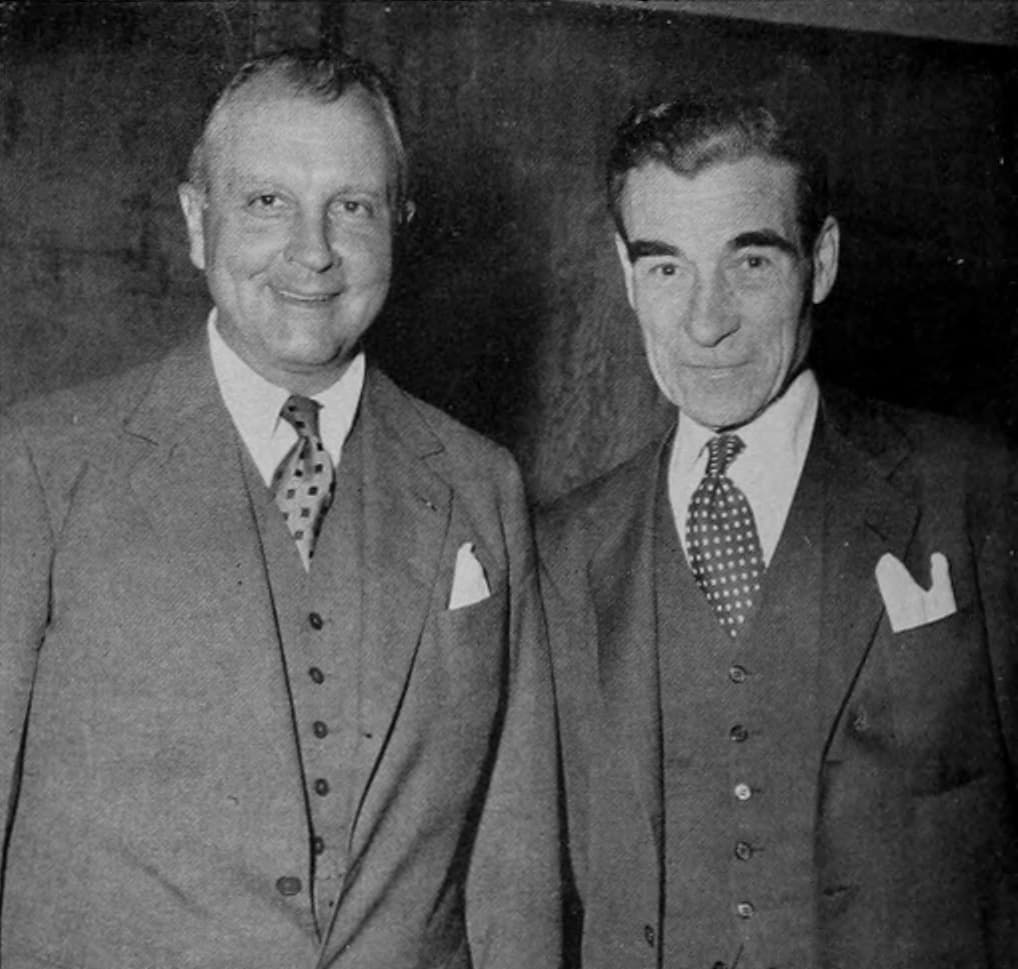
He built the network Washington needed
Trippe entered international aviation at the point where corporate nerve met strategic anxiety. Pan American Airways was incorporated in March 1927,[1] amid alarm in Washington over foreign aviation competition in the Caribbean basin and especially over German-linked SCADTA's possible approach to the Canal Zone. Trippe and his syndicate quickly moved into control, secured the Post Office's foreign airmail route from Key West to Havana, and got the first Pan Am mail flight into the air in October 1927.[2] Within a year the company had a ten-year foreign mail contract onward toward Panama, and Trippe used mail revenue, route rights, acquisitions, and relentless bargaining with foreign governments to turn a fragile start into an inter-American network.
The mechanics mattered. Pan Am did not grow by good feeling or by a generic faith in trade. It grew through contracts, aircraft orders, landing rights, and diplomatic support. Trippe's company negotiated country by country across the Caribbean and Latin America, sometimes scouting routes with Charles Lindbergh,[3] often with American diplomatic weight in the background. By 1930 Pan Am had become the largest air transport company in the world.[4] It remained a private corporation, but it was already doing something more than ordinary commerce. It was building the route structure through which American mail, passengers, business, and political presence would move.
The operator principal in its clearest historical form
Trippe belongs at the front of the canon because his case gives the doctrine its clearest historical grammar. The platform was private. The architecture around it was public. Pan Am was not a department dressed up as a company, and it was not a contractor waiting for orders. It was an operator principal raising capital, placing aircraft orders, standardizing a network, moving faster than the state could move on its own. Washington, for its part, treated outward aviation as a strategic field and gave Trippe what private operators in such fields always require: regulatory favor, mail subsidy, diplomatic backing, and a legal path to durable route rights.
Later writers called Pan Am the government's "chosen instrument."[5] The phrase needs one refinement, not a rejection. Trippe was chosen, yet he was not passive. He lobbied, pressed, improvised, and often shaped the policy climate from which he benefited. That is exactly why he is so useful to the doctrine. American economic statecraft does not arise when the state simply commands and business obeys. It arises when a private operator and the state converge around a strategic buildout, each using the other without collapsing the distinction between them.
The glamour hides real dependencies
Pan Am's romance should not obscure its dependence. The early network rested on mail pay, regulatory preference, and official pressure on behalf of one favored carrier. The company benefited from a near monopoly in overseas American aviation,[6] and the story of hemispheric modernity often softened the harder fact that Pan Am expanded inside an unequal American order in the Caribbean and Latin America. Critics are also right that the "chosen instrument" narrative can become too clean. Trippe was not merely used by the state. He helped create the strategic narratives from which he profited. Any serious use of him has to admit subsidy, policy intimacy, and the imperial optics of the wider order in which Pan Am flew.
The doctrine takes the operator model, not the favoritism
The lesson is not that the United States should recreate Pan Am as a protected champion. Strategic terrain can be built by a private operator when capital, legal permission, and diplomatic support line up behind a concrete platform — and that is the Trippe inheritance, not the monopoly itself. He joined execution to reach. He built the network, and the network altered America's position abroad.
What the doctrine refuses to copy is equally important: opaque favoritism, romantic monopoly, a strategic policy that cannot be defended in public. For present conditions, the updated Trippe lesson is sharper: pair operator speed with explicit legal architecture, host-country durability, and political-risk protection that can survive scrutiny. Reach is still the goal. The difference is that it must now be reach allied governments can consent to and capital markets can read — without the fiction that the operator is the state itself.
Sources
"Pan American World Airways," Wikipedia, accessed 2026; Robert Daley, An American Saga: Juan Trippe and His Pan Am Empire (Random House, 1980), 3–15.
Daley, An American Saga, 28–32; Matthew Josephson, Empire of the Air: Juan Trippe and the Struggle for World Airways (Harcourt, Brace, 1944), 47–53.
Josephson, Empire of the Air, 68–74. Lindbergh surveyed Caribbean and Latin American routes for Pan Am in 1927–1928 as a technical and publicity asset.
Daley, An American Saga, 98. By 1930 Pan Am operated the longest route network of any carrier.
Alan P. Dobson, Peaceful Air Warfare: The United States, Britain, and the Politics of International Aviation (Clarendon Press, 1991), 46. The "chosen instrument" framing was widely used in congressional and State Department discussions of overseas aviation policy.
Wesley Phillips Newton, The Perilous Sky: U.S. Aviation Diplomacy and Latin America, 1919–1931 (University of Miami Press, 1978), 112–120.