Statecraftsmen · Model
John Jacob Astor
Astoria proved that a privately financed commercial foothold can harden into geopolitical fact long after the original venture has failed.
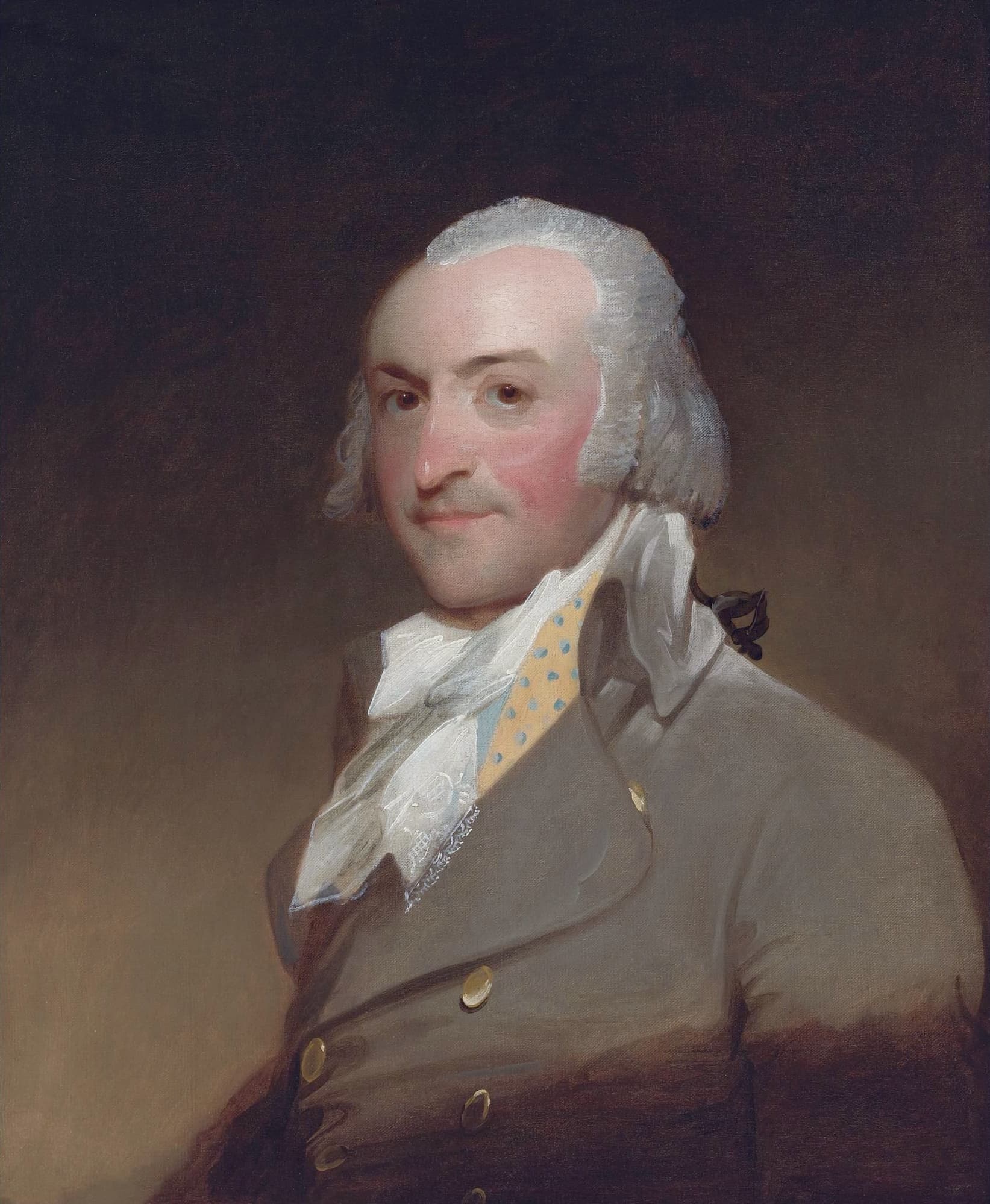
He tried to plant an American entrepôt on the Columbia
In 1810 Astor organized the Pacific Fur Company as the western arm of a larger commercial system he already controlled through the American Fur Company.[1] The design was ambitious and specific. Capitalize the venture, dispatch one expedition by sea on the Tonquin and another overland under Wilson Price Hunt, establish a depot at the mouth of the Columbia, draw furs down from interior posts, and push them outward through Pacific shipping into Russian and China trade. Contemporary accounts put the company's capital at $200,000, a large wager for a post so distant from New York that the entire project depended on supply lines across oceans and mountains.[2]
Fort Astoria rose in 1811 on the south bank of the Columbia, in Clatsop territory and inside a Chinook trading world the company did not control.[3] For a brief moment Astor had built what he wanted: a privately financed American commercial node on the Pacific coast, functioning as a receiving point, forwarding station, and symbol of American presence west of the mountains. The venture collapsed quickly under the pressures of war, supply failures, and competition from the North West Company, and the post was sold in 1813.[4] Yet its commercial failure did not erase its later strategic usefulness. Astoria entered the American record as evidence for the Oregon claim.
The statecraft lies in the sequence
Astor matters because he grasped a sequence that the doctrine still needs: build the commercial foothold first and let political strategy inherit the fact. He did not wait for the United States to plant a formal administrative order at the mouth of the Columbia. Using private capital, partnership articles, ocean transport, and a planned chain of interior posts, he put an American node where no comparable American node existed. That is the structural rhyme with modern doctrine. The operator moves first, inside legal and commercial forms that capital can understand, and the state later benefits from the presence, logistics, and claim-reinforcing reality the operator has created.
Astoria did not settle the Oregon question by itself — discovery claims, diplomacy, migration, and later treaty settlement all mattered. But the post gave those later arguments something concrete to stand on. A privately built commercial station had become geopolitical evidence.[5] Astor therefore belongs in the canon not as a moral exemplar in every respect, but as proof that commercial buildout can precede strategic consolidation and still matter decades later.
The frontier-colonial frame is real and has to be named
No serious profile can write Astor as a clean hero of expansion. Fort Astoria sat in Native territory, relied on Chinook and Clatsop intermediaries for food and trade, and belonged to a fur economy tied to coercion, ecological depletion, and eventual Indigenous dispossession.[6] The post was not planted in empty space. It entered an existing commercial and political world and then fed a larger American expansion that would not treat that world justly. Astor's wider commercial record, which included the China trade as well as the fur trade, also warns against moral simplification. The doctrine can use the structural lesson only by rejecting the older habit of treating westward commercial penetration as self-justifying because the republic later ratified it.
The doctrine takes the pre-positioning logic and rejects the setting
Astor's usable lesson is the power of private pre-positioning. A commercial node, once financed, inhabited, and made durable, can alter the strategic map. That is why he remains in the canon. But the update for present conditions is decisive: allied terrain cannot be built on the theory that the land is empty, the existing polity is incidental, or the people already there are background detail.
The doctrine takes the sequence, not the frontier. It takes the insight that built commercial facts can shape later state action, and it rejects the colonial frame in which those facts were too often produced. In modern terms, Astor is a model only if the corollary is stated plainly: strategic buildout abroad must proceed by consent, defensible law, and visible local legitimacy, or the project stops being statecraft and becomes conquest by nicer paperwork.
Sources
Washington Irving, Astoria, or Anecdotes of an Enterprise Beyond the Rocky Mountains (Carey, Lea & Blanchard, 1836), vol. 1, 1–18. Irving's account, written with Astor's cooperation, remains the foundational narrative source on the enterprise's design and capitalization.
James P. Ronda, Astoria and Empire (University of Nebraska Press, 1990), 21. Ronda gives the $200,000 capitalization figure and analyzes the venture's supply logistics.
Ronda, Astoria and Empire, 128–134. Ronda describes the post's placement in Clatsop territory and the Pacific Fur Company's dependence on Chinook and Clatsop intermediaries.
"Pacific Fur Company," Wikipedia, accessed 2026; Ronda, Astoria and Empire, 278–289. The sale to the North West Company took place in October 1813 amid the War of 1812.
Frederick Merk, The Oregon Question: Essays in Anglo-American Diplomacy and Politics (Harvard University Press, 1967), 3–14. Merk traces how Astoria figured in American arguments during the joint-occupation negotiations and the eventual 1846 treaty.
Ronda, Astoria and Empire, 136–142, 300–308. Ronda is direct about the coercive dimensions of the fur economy and the post's role in the longer dispossession of Pacific Northwest peoples.